
Automation is not optional if the UK wants to rebuild manufacturing
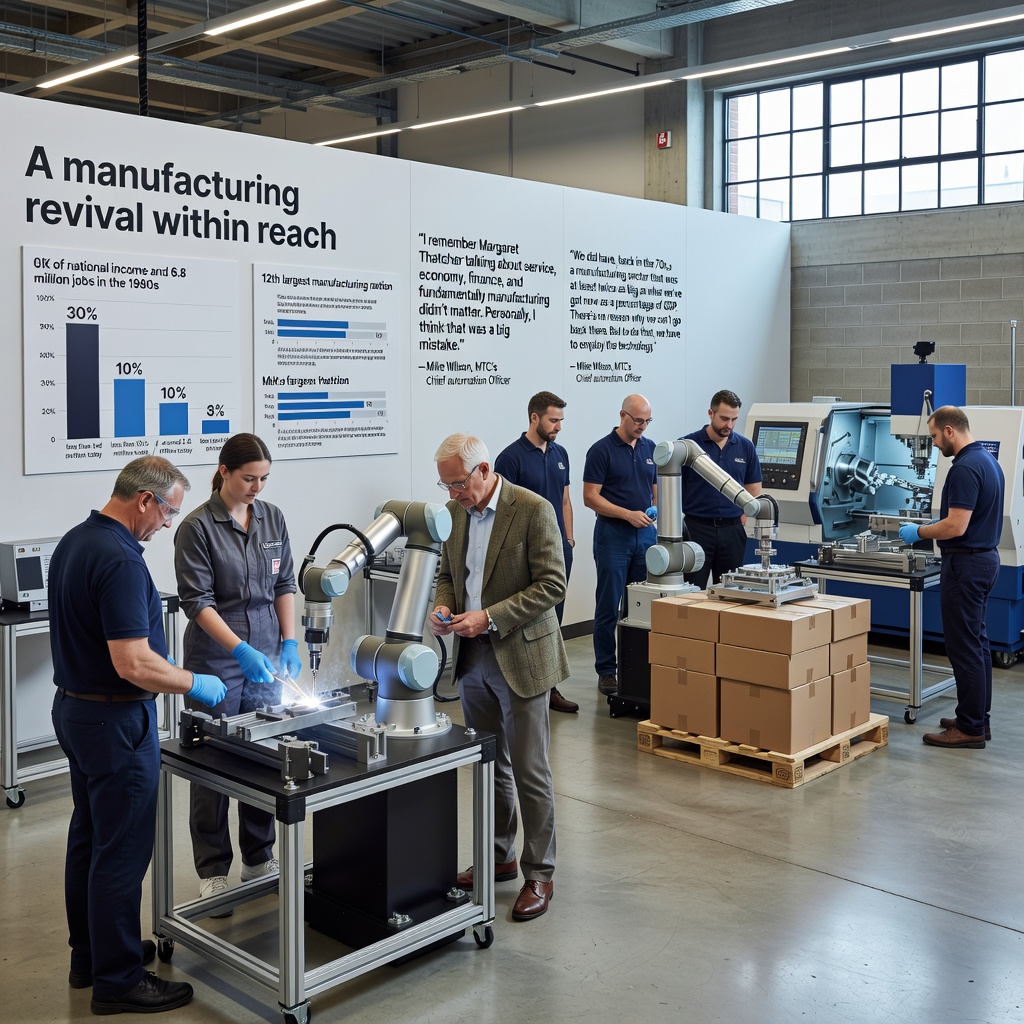
The United Kingdom’s manufacturing sector has shrunk dramatically since the 1980s—from roughly 30 percent of national income and 6.8 million jobs to less than 10 percent and around 2.6 million today. Yet Mike Wilson, chief automation officer at the Manufacturing Technology Centre (MTC), sees this decline not as a permanent state but as a challenge that can be reversed through technology.
“I remember Margaret Thatcher talking about service, economy, finance, and fundamentally manufacturing didn’t matter,” Wilson told Robotics & Automation News. “Personally, I think that was a big mistake. Our manufacturing sector has declined over the years. We’re still the 12th largest manufacturing nation in the world.”
Wilson believes the timing is right for a comeback. Governments on both sides of the Atlantic are rethinking supply-chain resilience and strategic independence, while rising labour costs in Asia, geopolitical tensions, and transport expenses are reshaping global manufacturing economics.
The Robot Experience Centre: lowering the barrier for SMEs
At the heart of Wilson’s optimism is the MTC’s newly opened Robot Experience Centre, a facility designed specifically to help small and medium-sized manufacturers take their first steps into automation.
“We’ve invested in the Robot Experience Centre primarily to support SMEs,” Wilson explained. The centre features robot systems for welding, palletizing, machine tending, and collaborative robots—applications that are common starting points for smaller firms. Companies can bring their own components for hands-on trials and receive impartial advice, since the MTC is a not-for-profit organization with no product to sell.
The UK’s robot density currently stands at about 119 robots per 10,000 manufacturing employees, far behind many industrial leaders. But Wilson views the gap as an opportunity rather than a weakness.
“We did have, back in the 70s, a manufacturing sector that was at least twice as big as what we’ve got now as a percentage of GDP,” he said. “There’s no reason why we can’t go back there. But to do that, we have to employ the technology.”
SMEs: the key to scaling up
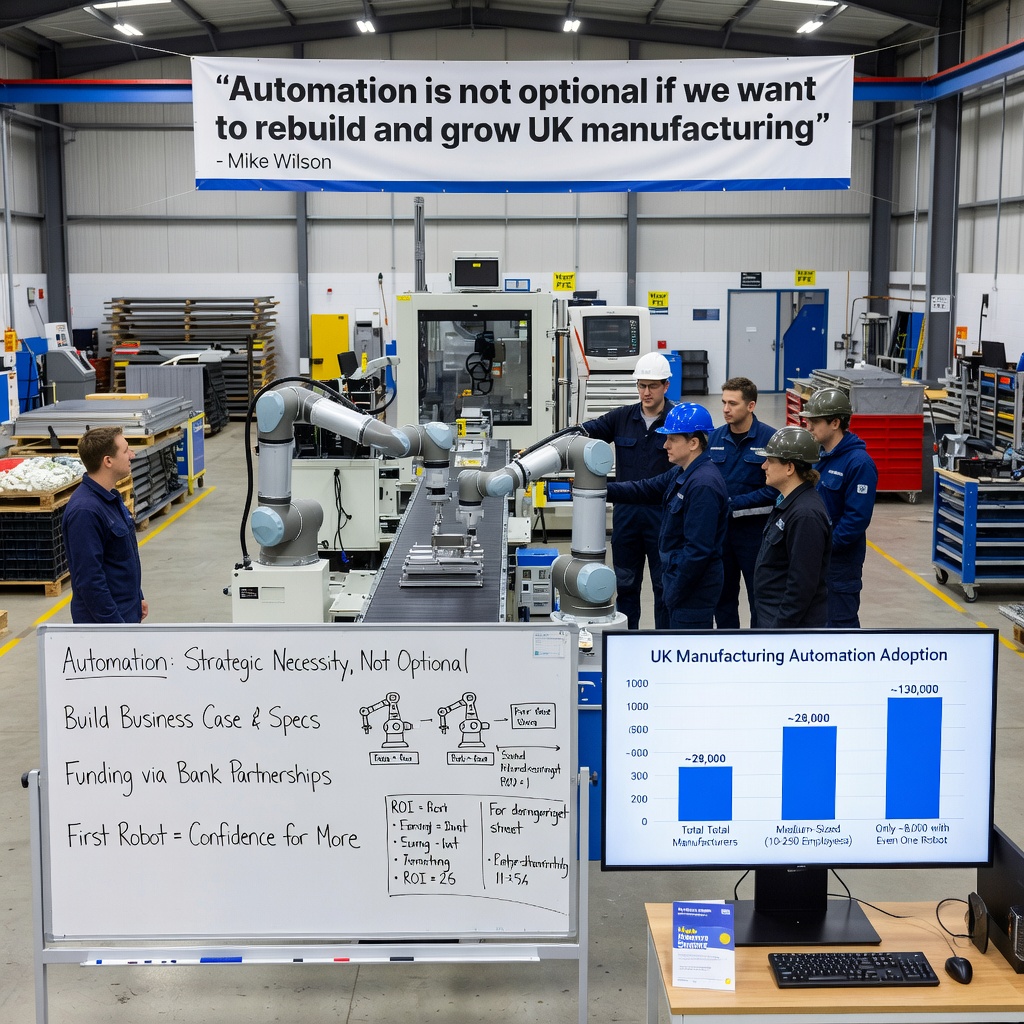
Wilson emphasised that the future of UK manufacturing depends heavily on its vast network of small and medium-sized businesses. Of the roughly 130,000 manufacturing companies in the UK, only a few thousand are large enterprises. Around 28,000 are medium-sized manufacturers employing between 10 and 250 people.
“Our estimate is that only around 8,000 of those businesses have even a single robot,” Wilson noted. “That means tens of thousands of manufacturers have not yet started their automation journey.”
Many SMEs view automation as risky because they lack familiarity with the technology. Wilson’s team focuses on helping companies build business cases, write specifications, and navigate funding options, often through partnerships with banks and finance providers.
“What we find is that once a company installs its first robot, it gains confidence and often invests in more automation,” he said. “Our aim is to help businesses make that first step.”
A strategic necessity, not an option
Wilson rejects the notion that automation is a luxury the UK can afford to ignore. Labour shortages and skills gaps across manufacturing are making it harder to rely solely on human workers. At the same time, global uncertainty is pushing firms to shorten supply chains and bring production closer to home.
“We need greater adoption of robotics and automation because that’s how manufacturers remain competitive globally,” Wilson said. “Automation is not optional if we want to rebuild and grow UK manufacturing.”
He points to government initiatives such as the industrial strategy and the Made Smarter programme as signs that policymakers recognise the importance of a stronger manufacturing base. Yet translating that recognition into action will require sustained investment and a willingness among businesses to embrace change.
“There’s no reason why we can’t go back” to a manufacturing sector that contributes twice as much to GDP, Wilson concluded. “But to do that, we have to employ the technology.”
The source for this article is https://roboticsandautomationnews.com/2026/06/22/interview-with-mtcs-mike-wilson-automation-is-not-optional-if-the-uk-wants-to-rebuild-manufacturing/102605/.