
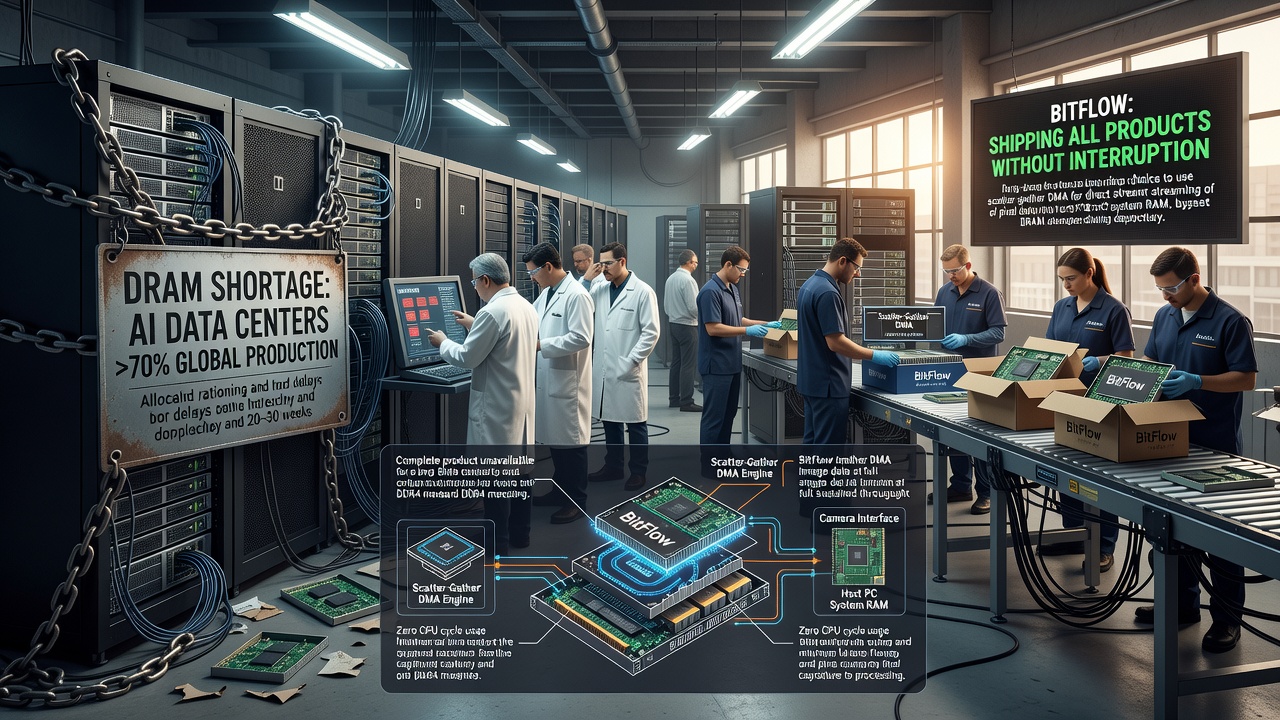
BitFlow's DDR-Free Frame Grabbers Ship On Time Amid Global DRAM Shortage
A critical global shortage of DRAM, driven by AI data centers consuming over 70% of worldwide memory production, is causing severe delays for frame grabber manufacturers that rely on onboard DDR4 memory. Lead times have stretched beyond 20–30 weeks, with allocation rationing and complete product unavailability becoming common. BitFlow, a division of Advantech, remains unaffected and continues to ship its entire product line—including the Axion, Aon, Claxon, and Cyton series—without interruption.
Why BitFlow Avoids DDR Memory
BitFlow’s immunity to the DRAM shortage stems from a long-standing architectural choice. Rather than using commodity DDR memory to buffer images, the company’s frame grabbers employ scatter-gather DMA to stream pixel data directly into the host PC’s system RAM. "When BitFlow adopted scatter-gather DMA for our frame grabbers, the goals were to use zero CPU cycles and guarantee the absolute minimum latency between when a pixel leaves the camera and when the user's program can begin processing it," said Donal Waide, Director of Business Development for iSystems at Advantech. "The fact that it also means we have no DDR dependency is paying dividends right now. Our competitors that built their frame grabbers around commodity DRAM are on backorder. We're not. BitFlow customers can order today and receive product."

How Scatter-Gather DMA Works
BitFlow’s design relies on three key components instead of DRAM. A scatter/gather DMA engine streams image data at full sustained throughput directly into user-allocated buffers in system or GPU memory, eliminating staging and redundant copies. Small FIFO buffers handle transient data flow without storing full frames, while static SRAM manages control-table configuration for video timing and camera signals. The approach not only sidesteps the DRAM supply chain but also reduces latency and CPU overhead. For applications in machine vision, semiconductor inspection, life sciences, and defense, BitFlow’s direct-DMA architecture supports sustained high data rates across Camera Link, CoaXPress, and other high-speed interfaces.
Immediate Availability
While hyperscalers and AI infrastructure builders have locked up production capacity for high-bandwidth memory (HBM)—consuming three to four times more silicon per gigabyte than standard DDR—DDR4 production is being phased out and DDR5 supply remains constrained. Industry forecasts suggest DRAM supply growth will trail AI demand well into 2027. BitFlow’s frame grabbers are currently in production and available for immediate order. Datasheets, specifications, pricing, and purchase options are accessible at www.bitflow.com.
The source for this article is https://www.roboticstomorrow.com/news/2026/07/06/ddr-free-architecture-keeps-bitflow-frame-grabbers-available-amid-global-memory-crisis-/26806/.