
Cobot Announces Second-Generation Proxie, Bringing Production-Tested Physical AI to Real Operations
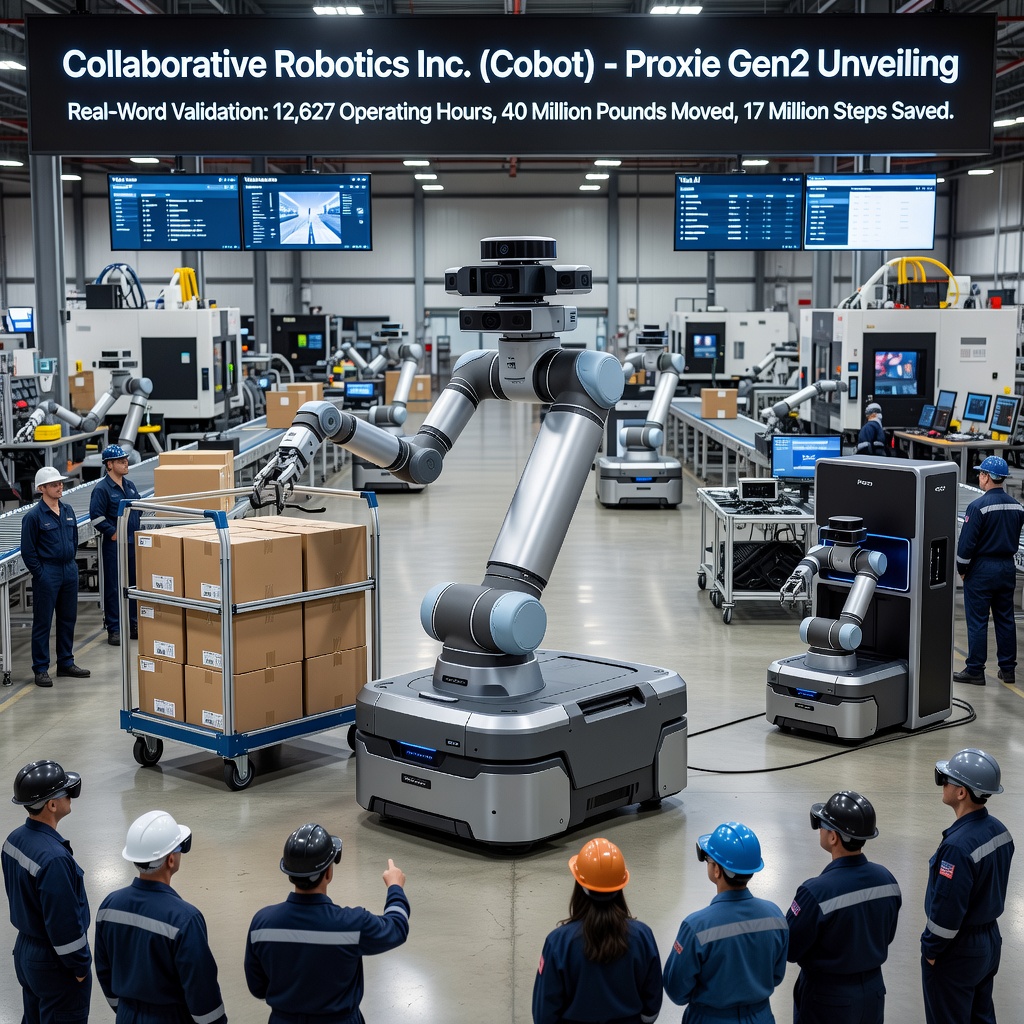
Collaborative Robotics Inc. (Cobot) today unveiled the second-generation Proxie, a general-purpose mobile collaborative robot that identifies tasks autonomously and executes them without any software integration. The Gen2 platform builds on the first-generation Proxie, which has accumulated 12,627 operating hours across hospitals, manufacturing floors, and logistics centers over the past two years. Often running 16-hour days, the fleet has moved over 40 million pounds of materials and saved more than 17 million steps for human workers.
Second-Generation Proxie: Key Upgrades
The Gen2 incorporates over 500 improvements derived from field experience. Designed for scale-up manufacturing, it features simplified assembly, 40% fewer parts, and lifecycle-tested components. The robot is more compact to navigate narrow hallways and elevators while increasing strength: it can move carts weighing up to 1,500 pounds and lift up to 200 pounds on its vertical spine. Proxie Gen2 also transitions to lithium iron phosphate batteries for industrial safety and includes a self-swapping battery station for continuous operation without downtime.
A modular option now enables two-armed interactions, leveraging the latest physical AI models for dexterous bimanual manipulation. Cobot says this configuration can quickly be trained to handle complex tasks such as hospital resupply, warehouse kitting, life sciences lab operations, and manufacturing line tending.
Physical AI and Autotasking
At the core of Proxie’s capability is its real-time world-model (RTWM), which it builds on the fly to self-identify work that needs to be performed. Cobot calls this Autotasking—it runs with no software integration and requires no human dispatcher. On-robot AI compute handles task inference locally, eliminating cloud dependency for core execution. Proxie’s ScoutSense sensor technology sees the workplace from human eye level, plans and sequences work, and audibly announces each action before moving.
Cobot’s Vista AI console provides operators with real-time visibility into every task as it is created, queued, and completed. It tracks fleet status and surfaces operational patterns, enabling teams to intervene before issues affect a shift. Unlike traditional business intelligence tools that explain past events, Vista manages current operations and helps shape what happens next.
“For decades, deploying robots has meant choosing between mobility and dexterity, and always required custom software integration,” said Brad Porter, founder and CEO of Cobot. “Our second-generation Proxie brings all of that together in one platform we designed end-to-end. It moves, manipulates, and orchestrates its own work. The robots identify what needs to be done, announce what they’re going to do, and then they just do it.”
Partnerships with NVIDIA and AWS
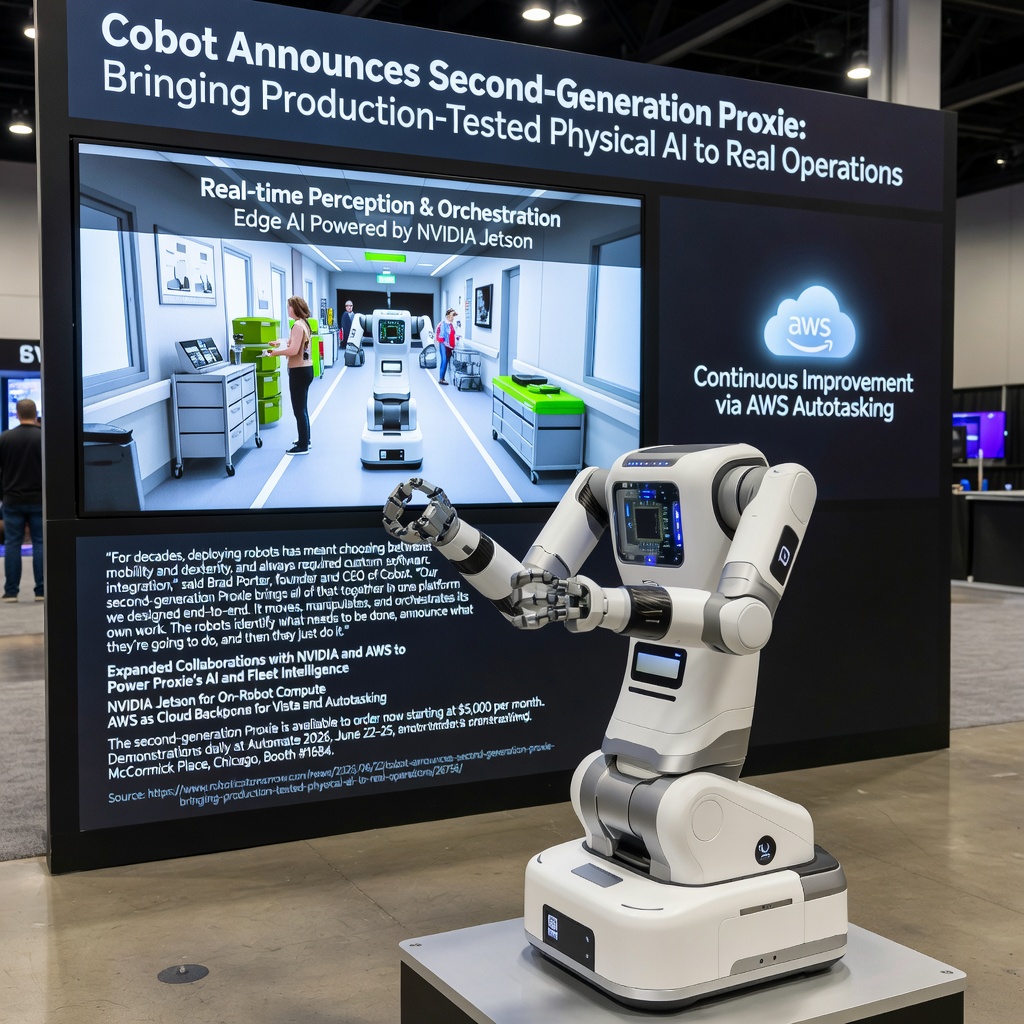
Cobot has expanded collaborations with NVIDIA and AWS to power Proxie’s AI and fleet intelligence. The NVIDIA Jetson platform provides on-robot compute for real-time perception, planning, and local task inference, enabling core work to execute on the edge. Cobot also works with NVIDIA Robotics on Isaac Sim and Omniverse NuRec for simulation, turning real-world deployment data into repeatable scenarios that accelerate validation and rollout.
“Physical AI is moving into real-world operations, where robots need to understand dynamic environments, reason in real time, and work safely alongside people without months of custom integration,” said Amit Goel, head of robotics and edge AI ecosystem at NVIDIA. “Cobot’s integration of NVIDIA Jetson for on-robot AI compute and NVIDIA Isaac Sim for simulation and validation helps Proxie move from development to deployment faster, bringing more adaptable automation to hospitals, logistics and manufacturing environments.”
AWS serves as the cloud backbone for Cobot’s fleet-level intelligence, powering Vista and Autotasking, enabling model training behind Proxie, and turning individual robots into a continuously improving autonomous fleet.
Availability and Pricing
The second-generation Proxie is available to order now starting at $5,000 per month. Cobot will demonstrate the platform daily at Automate 2026, June 22–25, at McCormick Place in Chicago, in booth #1684 within the Humanoid Pavilion hosted by NVIDIA.
The source for this article is https://www.roboticstomorrow.com/news/2026/06/22/cobot-announces-second-generation-proxie-bringing-production-tested-physical-ai-to-real-operations/26756/.