
Context is king: How Avride uses cloud VLMs as a safety net for delivery robots - The Robot Report
Avride Inc. has built its sidewalk delivery robots to operate with a high degree of autonomy, navigating busy city streets hundreds of times a day using onboard sensors and local neural networks. The robots handle standard maneuvers, pedestrians, and traffic lights without human intervention. However, the company recognized that managing the mechanics of navigation—even in challenging conditions like narrow pathways or bad weather—is only part of the equation. Ensuring appropriate behavior in unusual, sensitive, or high-stakes environments requires a different kind of intelligence.
To address this, Avride integrated heavy, cloud-based vision-language models (VLMs) into its system as an automated "VLM-watcher." This addition provides a proactive layer of environmental awareness that goes beyond basic object detection.
How the VLM-Watcher Works
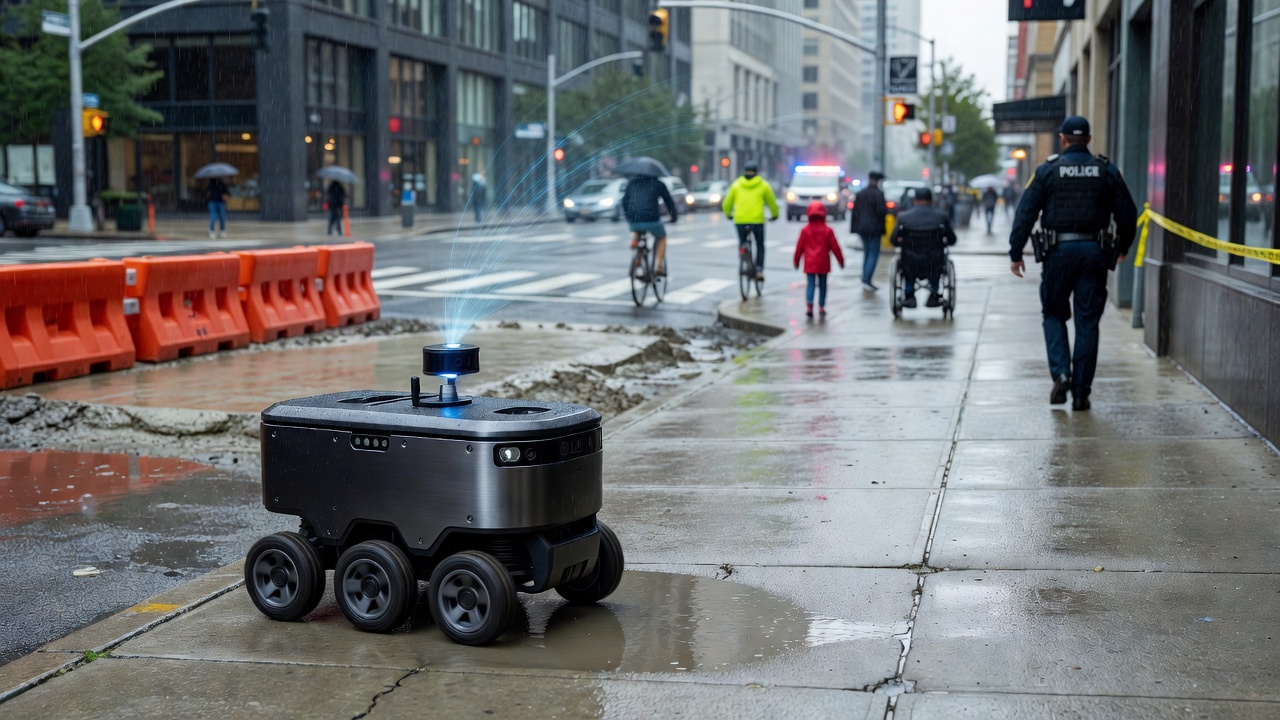
Avride’s onboard perception stack can already detect cyclists, children, wheelchairs, and emergency vehicles. But some scenarios demand deeper contextual understanding. For example, distinguishing a police officer walking home from an active crime scene requires interpreting how multiple elements interact within a frame. Robots could inadvertently enter an emergency area, cross a live crime scene, or roll into unmapped roadwork where fresh cement looks like a standard sidewalk.
The VLM is not used to drive the robot. Instead, it acts as an early warning system for Avride’s remote assistance team. The process involves three steps:
- Data ingestion: While driving autonomously, the robot transmits a snapshot from its cameras to the cloud every few seconds. All visual data is automatically anonymized on the robot—faces and license plates are blurred locally before the data leaves the onboard compute.
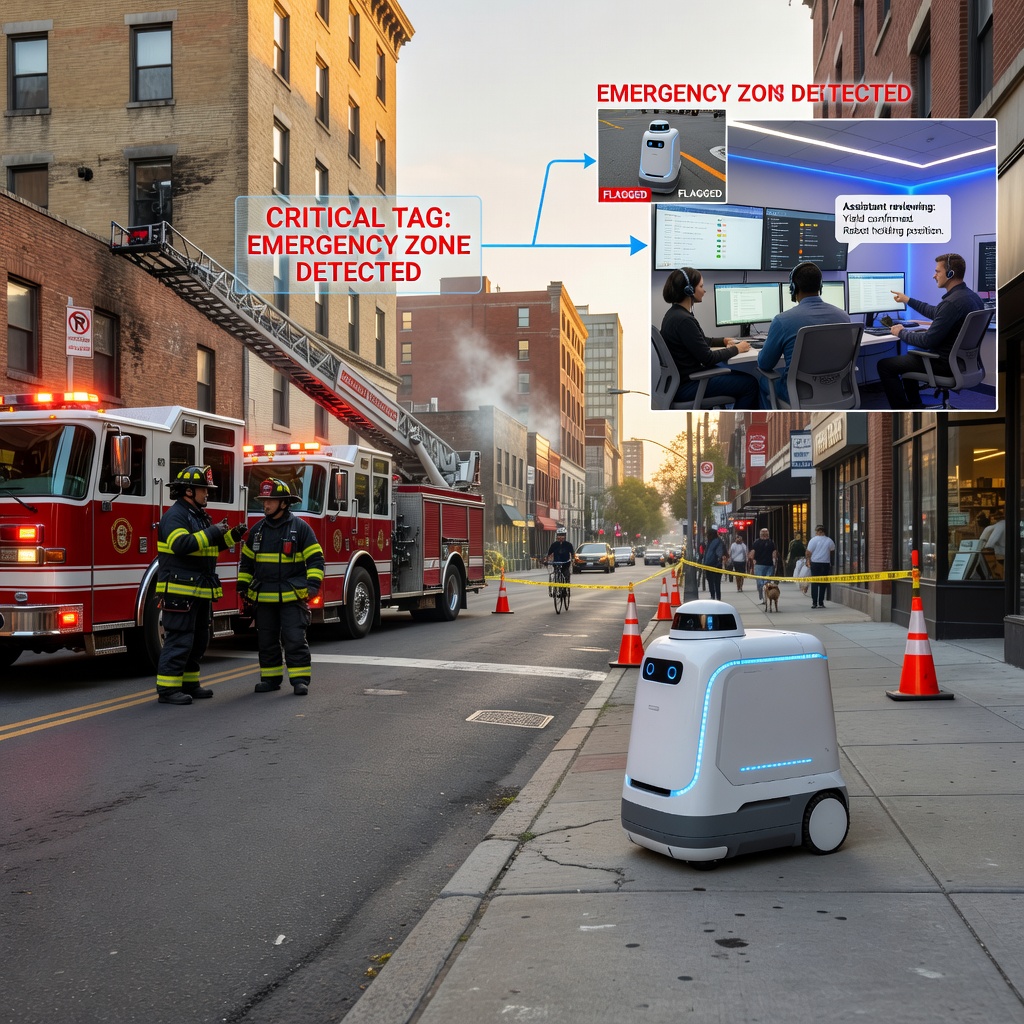
- Context evaluation: In the cloud, the VLM processes the snapshots and translates the visual data into a semantic description of what is happening on the street. A detailed prompt guides the model to identify specific unusual, sensitive, or complex situations, and assigns high-stakes tags to the scenes.
- Human-in-the-loop: If the model flags a critical situational tag, it alerts Avride’s remote assistance team. An assistant reviews the live feed to ensure the robot behaves appropriately—yielding to emergency workers or staying clear of restricted zones.
The company keeps its cloud layer open and plug-and-play, continuously testing new models to ensure accuracy.
From Data Mining to Live Operations
The integration of live VLMs into daily operations evolved from internal engineering tools. Storing every minute of video from hundreds of robots is expensive, so Avride originally used the same 5-second snapshot pipeline as a data-filtering tool. Cloud VLMs monitored incoming streams to automatically mine for rare, valuable scenarios—such as specific animal interactions or complex infrastructure—and saved pre-anonymized data for training.
As the pipeline proved exceptionally accurate at spotting unique real-world context live, it became a logical next step to extend the tool into live operations. The system could identify unique contexts in real time and trigger human oversight. This integration created a seamless bridge between cutting-edge AI and human assistance.
The Road Ahead
Operating heavy VLMs in the cloud is an effective solution for now, but Avride’s ultimate goal is to migrate this deep semantic layer directly onto the robot’s onboard compute. As VLMs become more compact through optimization techniques and next-generation hardware grows more powerful, the robots will achieve even deeper autonomous decision-making on the edge, independent of network connectivity.
Until then, the cloud-to-remote-assistance safety net ensures that Avride delivery robots remain polite, responsible, and aware citizens on the sidewalk.
The source for this article is https://www.therobotreport.com/how-avride-uses-cloud-vlms-safety-net-delivery-robots/.