
Develop Lightweight USD Runtimes Faster with AI Agents | NVIDIA Technical Blog
OpenUSD has long served as the open, extensible framework for describing 3D scenes in physical AI, unifying CAD data, simulation assets, and real-world telemetry. Yet building a compliant USD runtime has traditionally required adapting large existing codebases, even when teams need only a specific memory footprint, a different application binary interface (ABI), or unique performance characteristics. Now, a project called nanousd-labs offers an alternative: generating a runtime directly from the standard itself.
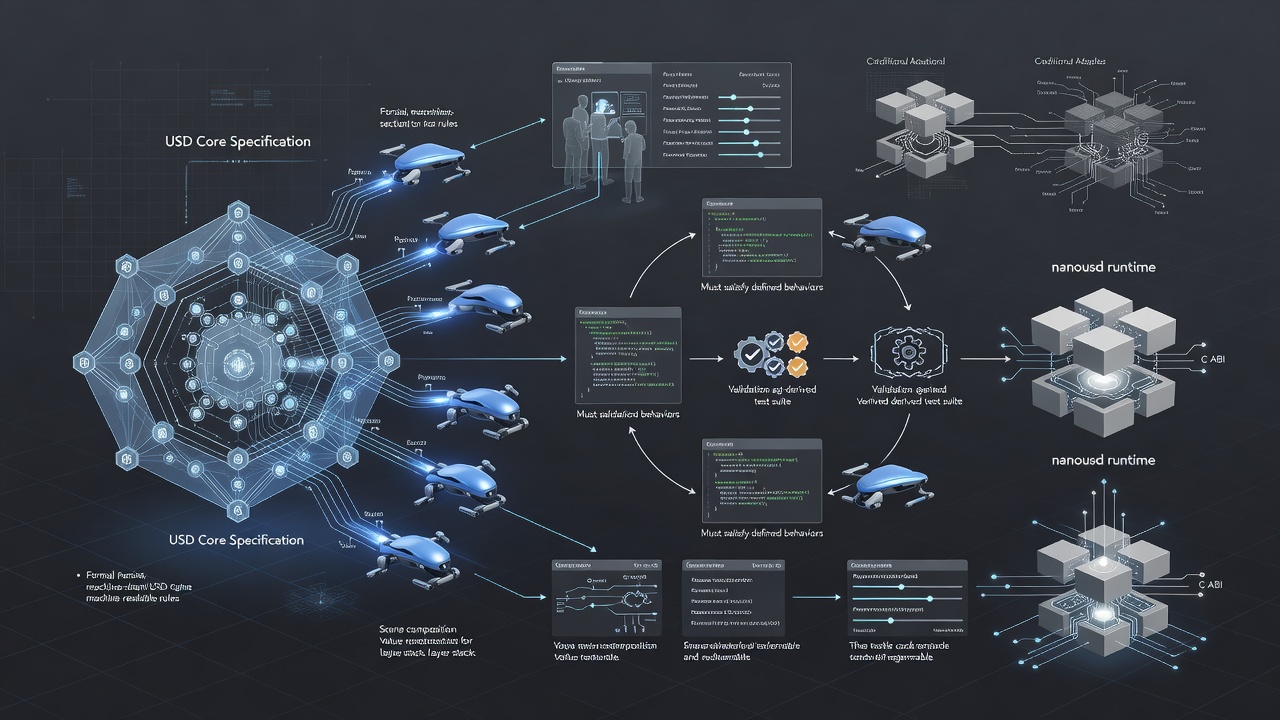
This approach is made possible because the USD Core Specification, maintained by the Alliance for OpenUSD (AOUSD), is a formal, machine-readable standard. It defines exactly how USD data models are composed and resolved across layer stacks, serving as a precise contract for both humans and AI agents. Developers can direct agents to generate only what a specific workload requires, complementing traditional adaptation or manual implementation.
How AI Agents Build Compliant Runtimes
The core idea behind nanousd-labs is to treat the USD Core Specification as the binding contract. Instead of modifying an existing codebase, agents read the specification directly, write code that must satisfy the defined behaviors, and validate the output against a test suite derived from the same standard. The process iterates until the generated code matches the specification requirements.
Agents consume the specification section by section, generating code for each behavior—parsing, scene composition, value resolution across layers—while engineers oversee performance tradeoffs and architectural decisions. Because the specification defines what a compliant runtime must do, not how it is built, the generated code remains elastic. Developers can regenerate the runtime for different constraints—memory, performance, language—without losing compliance.
nanousd: A Lightweight, Compliant Implementation
The nanousd runtime is an independent implementation of the USD runtime data model, derived directly from the Core Specification and exposed through a stable C ABI. Written in C++ with a public C API, it parses, composes, queries, and writes USD scenes but stops short of rendering. This design keeps the implementation lightweight and purpose-built, while existing OpenUSD stacks remain untouched.
Key to nanousd is its stable C ABI, which allows client code to compile against a fixed API and load the implementation at runtime. The backend can be swapped—OpenUSD or nanousd—without touching the calling code. This enables accurate performance comparisons and lets developers iterate toward the best fit for their workload.
Getting Started with nanousd-labs
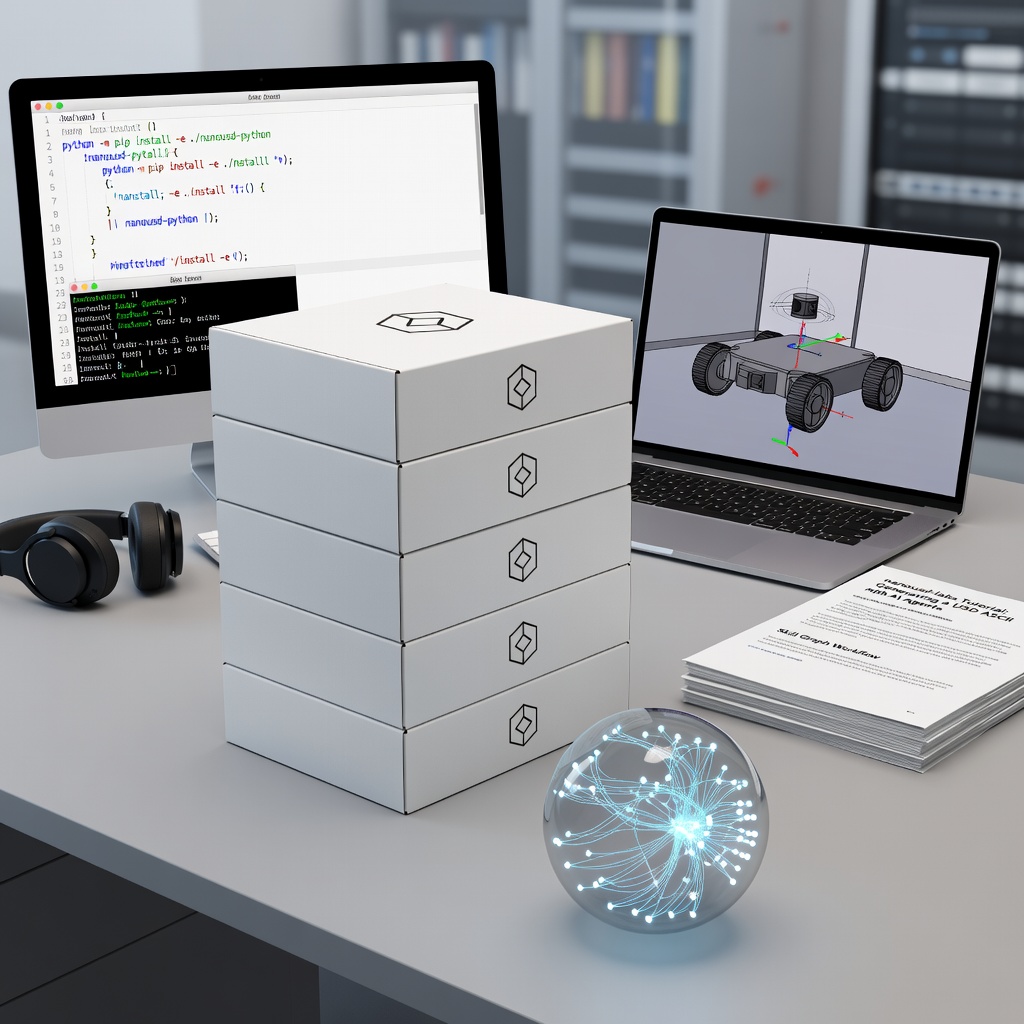
Developers have two entry points. The first is to build nanousd directly, using the C API from any language. Most physical AI developers will start with the nanousd-python package, which runs headlessly on any machine without a GPU. Installing it is straightforward:
python -m pip install -e ./nanousd-python
Once installed, opening a stage and walking its prims is simple. For example, an agent can author a USD stage for a warehouse AMR—including a base transform, lidar sensor, and instanceable wheel references—then compose it back to confirm compliance. The agent returns the resolved scene structure and flags any corrections needed to stay spec-compliant.
The second entry point is hands-on: a roughly 10-minute tutorial that walks through generating a USD ASCII parser using AI agents. This approach codifies human directions into reusable skills via a skill graph, capturing structured recipes, prompts, and tests. The skill graph is growing, and multi-part cohesion is the next frontier, but it provides a durable, reusable workflow.
The Future of Purpose-Built USD Runtimes
Building a lightweight USD runtime is now possible without starting from scratch. The USD Core Specification gives agents a precise foundation, and nanousd-labs proves the methodology in practice. Developers can contribute new skills, language support, and physical AI use cases on GitHub. AOUSD members can help shape the standard itself through the Core Spec Working Group. The standard is the durable foundation; nanousd-labs is one example of what becomes possible when agents and open standards work together.
The source for this article is https://developer.nvidia.com/blog/develop-lightweight-usd-runtimes-faster-with-ai-agents/.