

How Equipment Asset Management Practices Must Evolve for Industry 4.0 to Deliver on Its Promise
Industry 4.0 holds enormous potential: connected sensors feeding real-time data into intelligent systems, machines predicting their own failures, and production lines that self-optimise. Yet despite substantial investment and credible case studies, many manufacturers still face the same battles as a decade ago. Unplanned downtime continues to cost Fortune 500 companies an estimated $1.4 trillion annually, according to the Siemens True Cost of Downtime 2024 report. Maintenance teams with IIoT sensors on half their assets still spend most of their time reacting to failures rather than preventing them.
The root cause is not the sensors or algorithms, but the asset management infrastructure beneath them. Enterprise Asset Management (EAM) systems, built for a different era, struggle to support Industry 4.0 technology. When smart technology is layered on outdated EAM infrastructure, the result is islands of intelligence that cannot communicate and insights that fail to reach decision-makers.
The EAM Gap: Smart Technology on Dumb Infrastructure
Deloitte’s 2025 Smart Manufacturing and Operations Survey found that 46% of manufacturers are actively using Industrial IoT solutions, and many have deployed predictive maintenance. However, interoperability remains a critical shortfall. An IIoT sensor streaming vibration data to a dashboard not connected to the work order system does not prevent failures; it merely provides a graph to watch during the breakdown.
This is the "EAM gap": the disconnect between intelligence generated by modern technology and the operational decisions that actually get made. Legacy EAM systems, designed around fixed-schedule, work-order-driven models, cannot ingest continuous sensor streams, apply dynamic criticality scoring, or adjust reorder points based on changing failure probabilities. Alerts fire without context; work orders are generated manually; criticality scores are updated only every few years; and spare parts catalogues deteriorate with duplicate entries and inconsistent naming conventions.
Data Quality: The Underlying Obstacle
Nearly 70% of manufacturers cite data quality, contextualisation, and validation as the most significant obstacles to AI implementation, according to Deloitte. IIoT sensors generate data, but EAM systems must give that data meaning by connecting vibration readings to specific assets, maintenance histories, criticality scores, required parts, and suppliers. When the EAM data layer is fragmented and duplicated, Industry 4.0 intelligence cannot make sound decisions.
What Traditional EAM Was Designed For—and What Industry 4.0 Needs
Traditional EAM architecture assumed maintenance events are discrete and scheduled, asset data is relatively static, and human planners serve as the primary intelligence layer. None of these hold in a connected industrial environment. Failure modes ignore schedules; asset condition changes continuously; and data volumes far exceed human processing capacity.
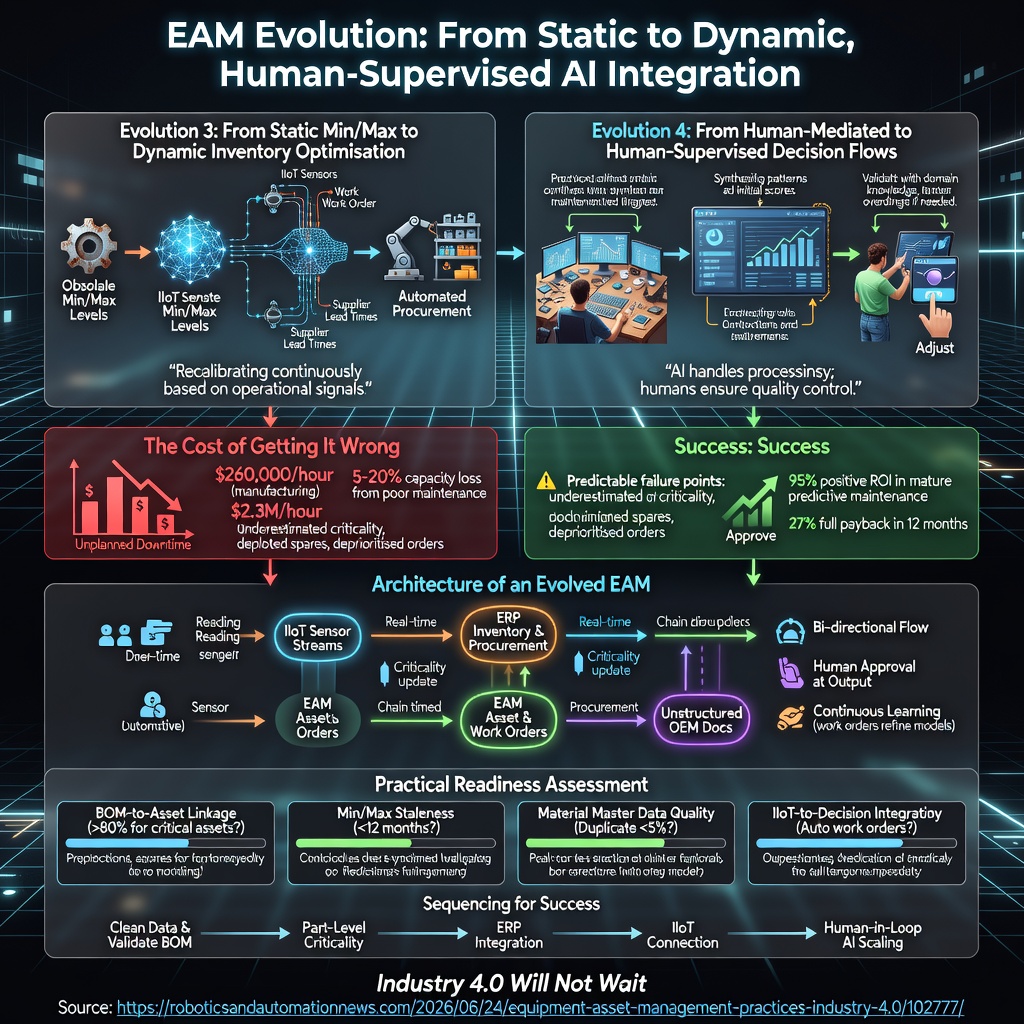
Most organisations have reached Stage 3 of EAM maturity: predictive and condition-based maintenance with IIoT sensors and data collection. The gap to Stage 4—where IIoT, EAM, ERP, and AI layers are integrated in real time—is not technological but a matter of integration and data infrastructure.
The Impact of True Integration
When the four layers are genuinely integrated, outcomes are measurable. McKinsey research documents maintenance cost reductions of 18–25% and unplanned downtime reductions of up to 50%. A Deloitte case study found an 80% reduction in unplanned downtime for a chemical manufacturer’s asset class, with savings of $300,000 per asset. The difference lies not in sensor quality but in whether intelligence connects to maintenance decision systems.
Four Critical Evolutions for EAM Practice
Evolution 1: From Asset-Level to Part-Level Intelligence
Legacy systems manage criticality at the asset level, but a low-cost seal with a 14-week sole-source lead time on a critical compressor carries a different risk profile than an identical seal with multiple suppliers. Part-level criticality scoring, driven by continuous analysis of lead times, supplier reliability, and failure patterns, enables automated inventory adjustments.
Evolution 2: From Periodic Reviews to Continuous Data Governance
Duplicate material records, inconsistent descriptions, and broken BOM linkages accumulate over years. Periodic data cleansing projects are expensive and temporary; within 18–24 months, catalogue quality degrades again. Industry 4.0 requires an AI-native layer that monitors the catalogue in real time, surfaces duplicates, flags obsolescence, and maintains data standards automatically.
Evolution 3: From Static Min/Max to Dynamic Inventory Optimisation
Most facilities set inventory levels annually or less frequently, leading to stocking decisions based on obsolete conditions. Dynamic inventory optimisation connects min/max levels to live operational signals—work orders, IIoT condition data, production changes, and supplier lead times—recalibrating continuously and triggering automated procurement when critical parts fall below dynamically calculated thresholds.
Evolution 4: From Human-Mediated to Human-Supervised Decision Flows
The maintenance planner historically synthesised data from multiple systems. That model does not scale. The evolution shifts human judgment to a quality-control role above AI processing. AI handles data synthesis, pattern recognition, and initial scoring; human planners review, validate, and override where domain knowledge warrants. This preserves institutional knowledge while eliminating cognitive bottlenecks.
The Cost of Getting It Wrong
Siemens’s 2024 report indicates average manufacturing facilities lose $260,000 per hour of unplanned downtime; in automotive, that figure reaches $2.3 million per hour. Deloitte found poor maintenance strategies reduce productive capacity by 5–20%. These costs cluster around predictable failure points: underestimated criticality, depleted spare parts due to obsolete reorder points, and deprioritised work orders from lack of real-time visibility.
As one industry observer noted, the gap between Industry 4.0’s promise and delivered results is almost always an EAM problem in disguise. Conversely, organisations with mature predictive maintenance see positive ROI in 95% of cases, with 27% achieving full payback within 12 months (IoT Analytics survey).
Architecture of an Evolved EAM
An Industry 4.0-ready EAM is not a single platform but an integration layer connecting four data domains: IIoT sensor streams, ERP inventory and procurement data, EAM asset and work order records, and unstructured OEM documentation. Key characteristics include:
- Bi-directional data flow: A single sensor reading triggers chain updates through asset criticality, parts availability, work order scheduling, and supplier lead time checks.
- Human approval at the decision output stage, not data processing: Planners review proposed actions with full reasoning.
- Continuous learning: Work order completion updates failure probability models, which adjust criticality scores and stocking recommendations.
Practical Readiness Assessment
Four questions determine EAM readiness:
- How complete is BOM-to-asset linkage? Below 80% for critical assets indicates missing part-level context.
- How stale are min/max levels? If more than 12 months since last review, safety stock settings reflect outdated conditions.
- How clean is material master data? Duplicate rates above 5% mislead planners. Nearly 70% of manufacturers cite data quality as primary AI obstacle.
- Are IIoT signals connected to maintenance decisions? If condition alerts cannot automatically generate work orders, check parts availability, and update priority, the investment is underutilised.
Sequencing for Success
Attempting everything simultaneously often leads to failure. Recommended order:
- Clean material master, validate BOM linkages, and establish continuous governance before deploying AI.
- Run part-level criticality before recalibrating inventory settings.
- Integrate ERP procurement and inventory data first, then IIoT.
- Establish human-in-the-loop approval before scaling AI—planner overrides are crucial for model improvement.
Industry 4.0 Will Not Wait
The smart factory investment cycle has created momentum, but asset management practice has not kept pace. The organisations that realise the most from Industry 4.0 will be those with EAM infrastructure capable of connecting sensors and models to maintenance, inventory, and procurement decisions in real time, at scale, with human judgment applied where it adds most value.
The EAM evolution is a data discipline and operational commitment. As industry experts conclude, Industry 4.0 is not a failure of technology but of the data and process layer meant to connect technology to action.
The source for this article is https://roboticsandautomationnews.com/2026/06/24/equipment-asset-management-practices-industry-4-0/102777/.