
How Intrinsic Eliminates Manual Robot Coding
Alphabet subsidiary Intrinsic is redefining industrial robotics with a modular, software-first workcell powered by its IntrinsicOS platform. The company aims to democratize industrial AI by replacing complex manual robot programming with a drag-and-drop automation interface. This innovation precedes a major manufacturing pilot with Foxconn scheduled for later this year.
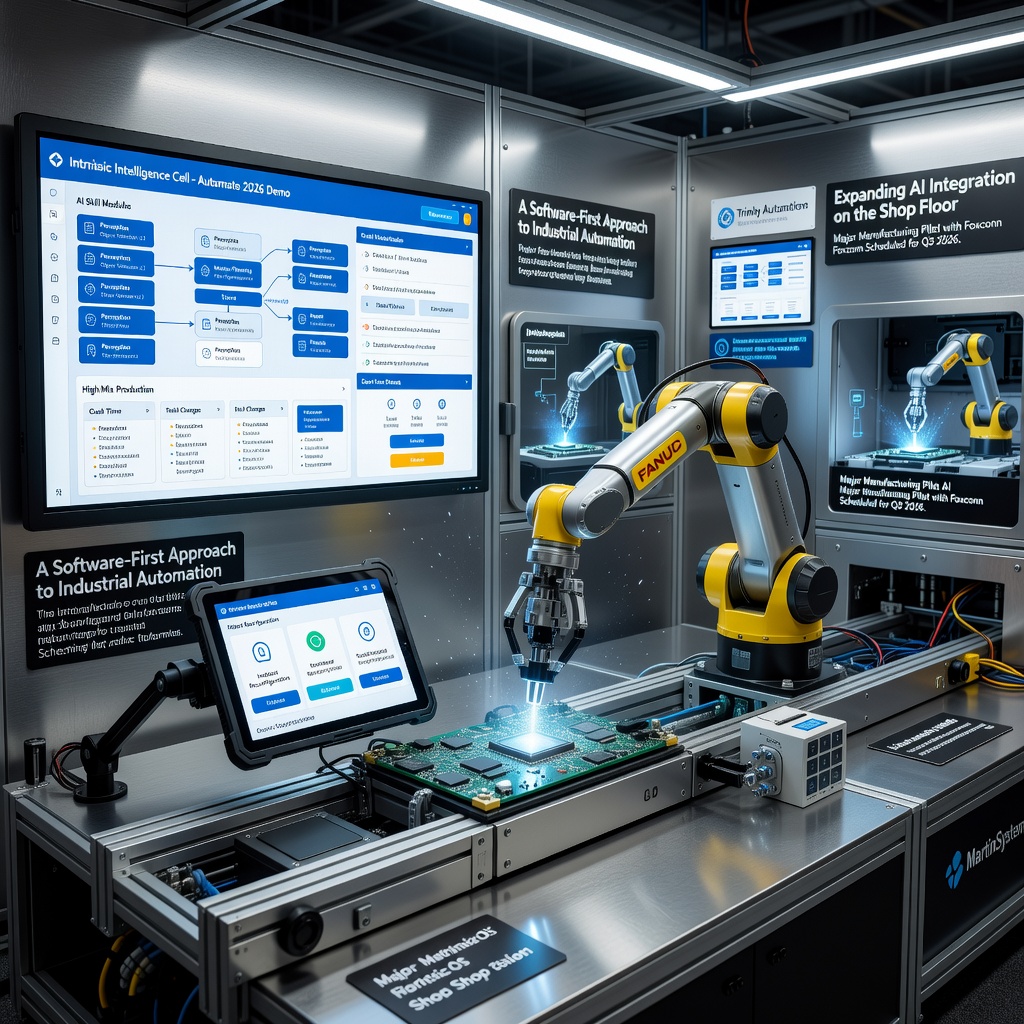
At Automate 2026, Intrinsic is showcasing the Intrinsic Intelligence Cell to demonstrate the potential of modular, AI-infused production systems for applications ranging from factories to machine shops. The workcell leverages IntrinsicOS and AI to rapidly implement skills-based automation for intricate assembly tasks. Capabilities include instant process and tool reconfigurations, enabling “high mix” production of smaller custom batches. The demonstration features a FANUC robot performing electronic assembly.
Expanding AI Integration on the Shop Floor
Intrinsic is collaborating with CNC system integrators such as Trinity Automation and MartinSystems to embed AI skills seamlessly into next-generation products. These systems are designed for straightforward, manageable use on the machine shop floor, eliminating the need for traditional robot programming. By integrating AI capabilities—such as perception, automated motion planning, and part grasping and insertion—the platform brings robotic assistance directly to machine operators.
The company has also reaffirmed its commitment to supporting ROS developers, helping them transition smoothly from prototyping to production.
Global Developer Challenge Seeks Breakthroughs in Cable Manipulation
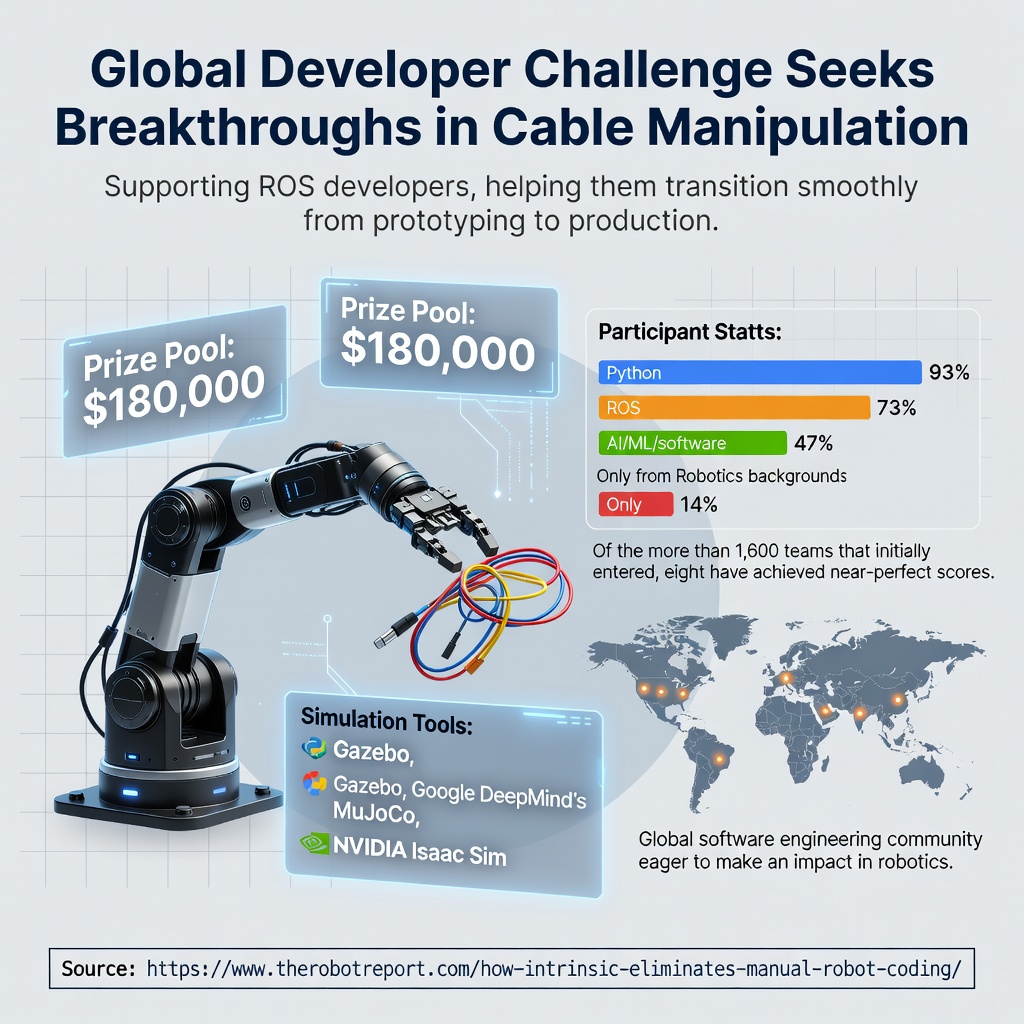
As part of its push to unlock new value in the electronics industry with software and AI-driven solutions, Intrinsic has opened broader access to the global developer community. Together with co-organizer Open Robotics, Intrinsic launched the global AI for Industry Challenge in 2025. The challenge focuses on one of the most difficult problems in electronics assembly: the dexterous manipulation of cables and connectors. With a prize pool of $180,000, it invites the world’s top software and robotics developers to team up and tackle this intractable problem using a variety of open-source tools, including Gazebo, Google DeepMind’s MuJoCo, and NVIDIA Isaac Sim.
Of the more than 1,600 teams that initially entered, eight have achieved near-perfect scores through the simulation evaluation process. Notably, 93% of participants are proficient in Python, 73% in ROS, and 47% work in AI, ML, and software engineering industries. Only 14% of participants come from robotics backgrounds, underscoring strong interest and untapped potential from the global software engineering community eager to make an impact in robotics.
The source for this article is https://www.therobotreport.com/how-intrinsic-eliminates-manual-robot-coding/.