
Humanoid Unveils KinetIQ Ascend: Reinforcement Learning System Nears Human-Level Manipulation Speed and Precision
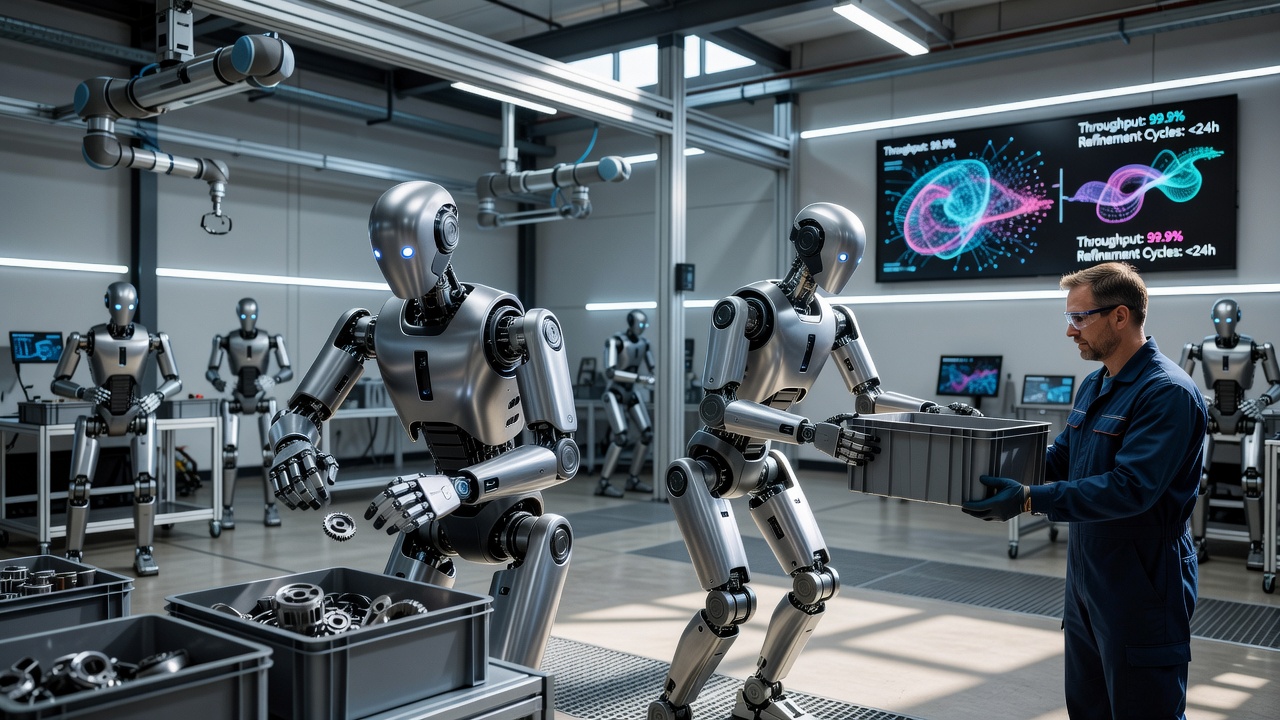
London-based robotics company Humanoid has announced KinetIQ Ascend, a reinforcement learning (RL) framework designed to push robotic manipulation reliability to 99.9% while operating at or beyond human speed. The system marks a significant step in making humanoid robots practical for industrial use, according to the company.
“The humanoid race is becoming a question of scale, and real-world RL can be a core part of the answer,” said Jarad Cannon, chief technology officer at Humanoid. “Robots that once required months of manual tuning are now outperforming human demonstrations within days.”
Founded in 2024 by Artem Sokolov, Humanoid aims to become the world’s leading general-purpose industrial humanoid robotics company within two years. The firm employs over 250 engineers and researchers, with offices in London, Boston, Vancouver, and San Diego. In May, Humanoid partnered with Bosch and Schaeffler to ramp up production of its HMND robots.
KinetIQ Ascend Powers a ‘Capability Factory’
Humanoid describes KinetIQ as its proprietary four-layer AI framework designed for real-world deployment. KinetIQ Ascend builds on the earlier KinetIQ platform by incorporating trial-and-error learning, enabling robots to refine industrial tasks directly on the job.
“Instead of spending months collecting data and manually tuning every new skill, we can start with a basic behavior and allow RL to refine it into a deployment-ready capability – a process we describe as building a ‘capability factory,’ which marks how humanoid robots move from impressive demos to tools that industry can actually rely on,” said Cannon.
Test Results Show Dramatic Gains in Speed and Reliability
Humanoid tested KinetIQ Ascend across several real-world operations, including picking parts from bins, handing objects to humans, and lifting and moving containers with two arms. The company reported consistent improvements in throughput and success rates.
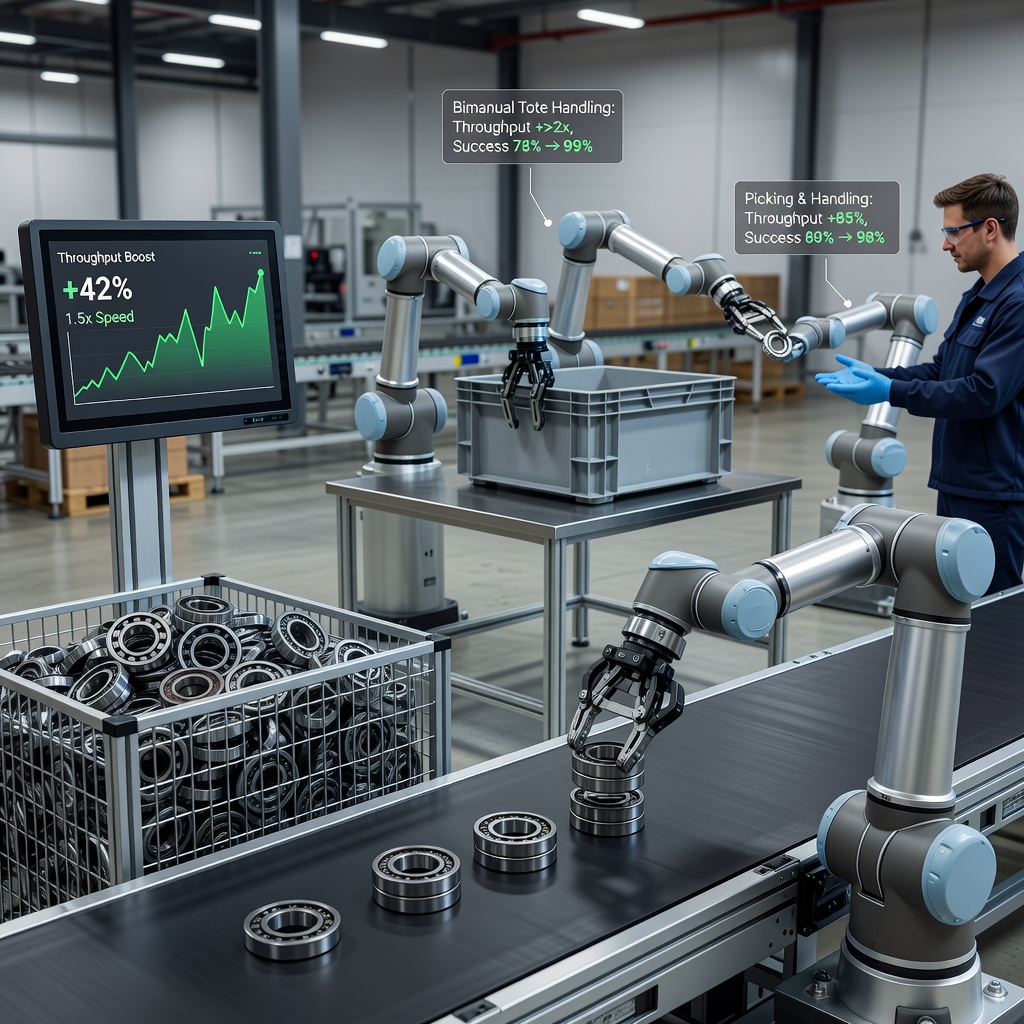
In a machine-feeding task, a robot picked steel bearing rings from a bin and placed them onto a conveyor. KinetIQ Ascend boosted throughput by 42%, allowing the robot to operate at 1.5 times the speed of the human demonstrations it originally learned from.
For picking items from a cluttered tote and handing them to a person, throughput increased by 85% while success rates climbed from 80% to 98%. In a more complex bimanual tote-handling task—lifting a tote from a table using both arms—throughput more than doubled, and success rates rose from 78% to 99%. This represented roughly a twentyfold reduction in failures. All results were achieved after only a few days of training.
“The results demonstrated that KinetIQ Ascend shows a new way of developing robot capabilities, proving effective across a range of real-world operational tasks, from high-speed single-arm picking to complex bimanual handling,” the company stated.
Scaling Behavior Mirrors Large Language Models
Humanoid noted that KinetIQ Ascend also exhibited a predictable improvement in performance as training time increased—similar to how large language models (LLMs) improve with more compute and data. The company said simulation experiments suggest the method scales all the way to 100% reliability.
Additionally, the approach revealed two unexpected findings: focusing on the hardest part of a workflow improved the entire task, and robots were able to generalize to objects they had not encountered during training. Humanoid detailed these results in a new technical report covering the full methodology, training infrastructure, algorithmic solutions, and deeper analysis.
The source for this article is https://www.therobotreport.com/humanoid-announces-kinetiq-ascend-reinforcement-learning-approach/.