
MIT Forum Examines AI’s Societal Impact on Labor, Democracy, and the Arts
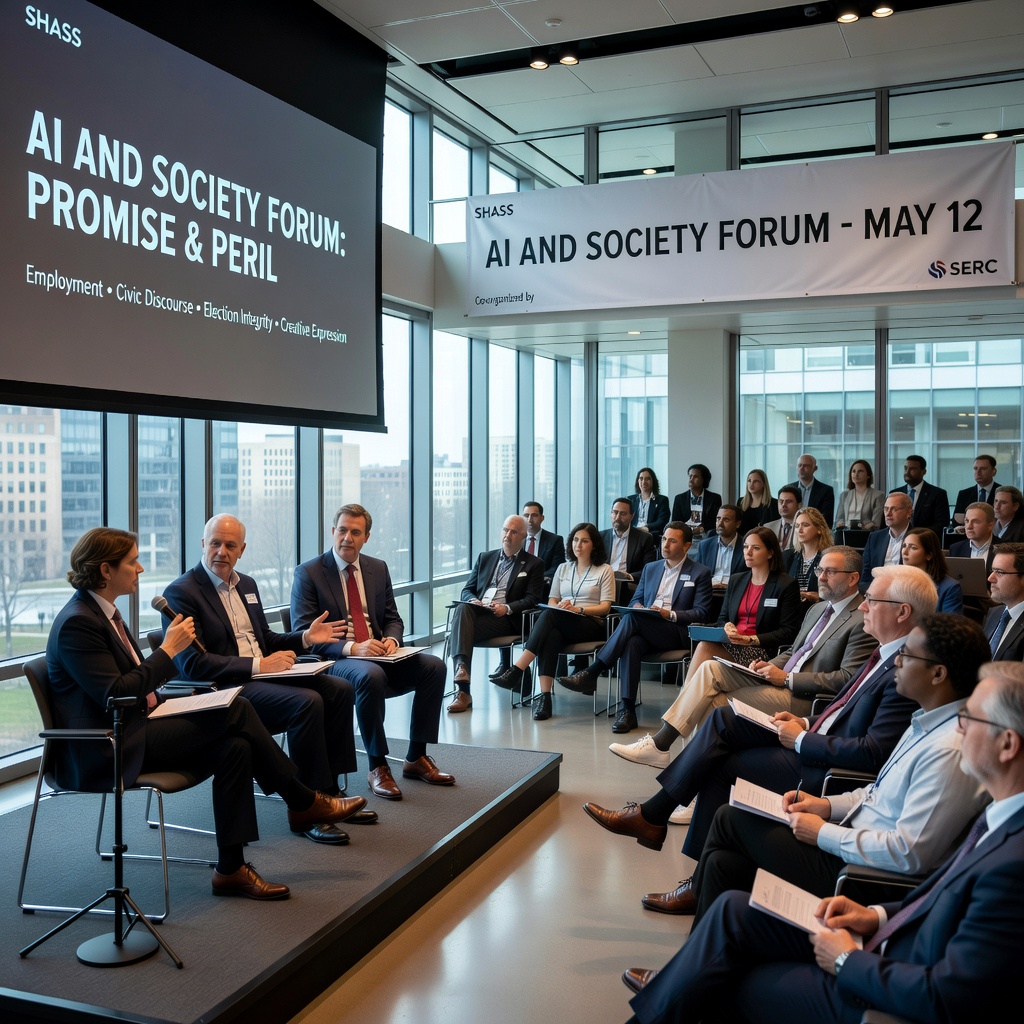
Experts from across the Massachusetts Institute of Technology gathered on May 12 for the AI and Society Forum, a daylong event that explored both the promise and peril of artificial intelligence in areas ranging from employment and civic discourse to election integrity and creative expression. Co-organized by the School of Humanities, Arts, and Social Sciences (SHASS) and the Social and Ethical Responsibilities of Computing (SERC), the forum featured research presentations, panel discussions, and a musical performance that showcased generative AI in the arts.
Opening Remarks Set the Stage for Interdisciplinary Dialogue
Agustín Rayo, the Kenan Sahin Dean of SHASS, and Dan Huttenlocher, dean of the MIT Schwarzman College of Computing, opened the forum with a call for cross-disciplinary collaboration. Rayo emphasized that examining AI’s societal consequences is integral to MIT’s mission, stating, “Paying attention to the societal consequences of AI is not a departure from MIT’s mission; it’s a way of ensuring that our technical leadership has maximum impact.” Huttenlocher echoed that sentiment, noting that rapid advances in computing and AI make such conversations urgent. “Understanding where AI excels and where it falls short is essential not only to unlocking its benefits, but also to avoiding critical errors, overreliance, and unintended consequences,” he said.
Rethinking Automation’s Effect on Jobs and Human Expertise
Economist David Autor kicked off the first session with a keynote that challenged the prevailing narrative that AI will simply eliminate jobs. Instead, Autor argued that technology’s impact hinges on how it alters the scarcity and value of human expertise. “When I think about how technology interacts with the value of labor, I think about it in terms of how it changes the scarcity of expertise, whether it makes it more valuable or whether it makes it more of a commodity,” said Autor, who holds the Daniel (1972) and Gail Rubinfeld Professorship in MIT’s Department of Economics. He predicted that AI would create new specialized work, but warned that such outcomes require proactive policies on worker training, wage insurance, and broader capital ownership.
A panel moderated by Rob Loughlin of McKinsey & Company brought together experts to discuss how work is evolving. Daniela Rus, director of the Computer Science and Artificial Intelligence Laboratory (CSAIL), envisioned a future where AI acts as a collaborative assistant. “I’d like to imagine the robot as your friend and assistant, as someone who watches you and figures out how to help you as someone you can task at a high level,” she said. Yet she stressed that human judgment remains essential: “The role of the human as the decider, as the person with good judgment, as the person deciding the next step, whatever that is, remains super important.”
David Mindell, a professor of aeronautics and astronautics and the Dibner Professor of the History of Engineering and Manufacturing, noted that the nature of work has always evolved, and the key is supporting the creation of new roles. “We need to be supporting individuals, the economy, professions, to constantly be creating the new work,” he said. “It’s absolutely imperative that we give the tools to the young people and let them do what they find creative and show us what the new work is going to be.” Panelists also discussed safety standards, with Mindell citing the example of cargo flights requiring six pilots: “We don’t know how to take that six number down to five yet, much less two, one, or zero.”
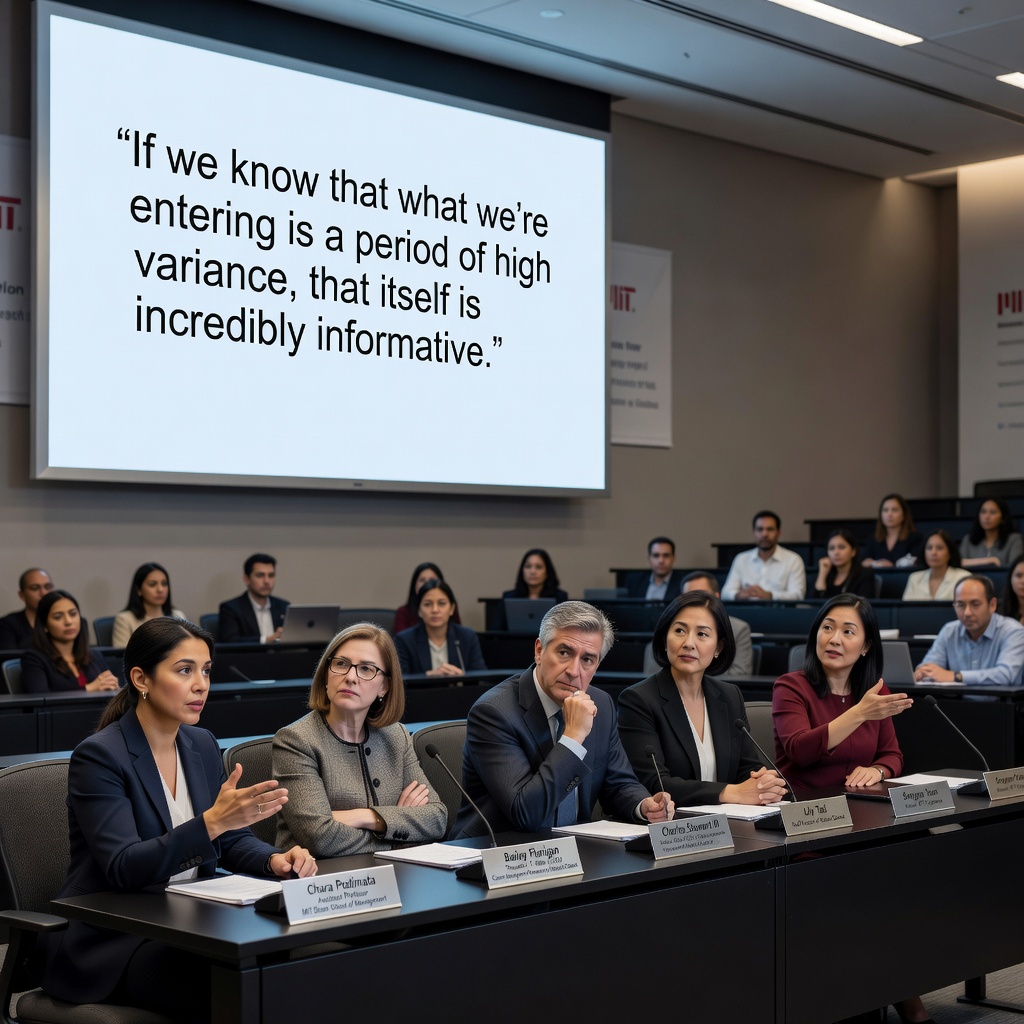
Sendhil Mullainathan, the Peter de Florez Professor with appointments in both economics and electrical engineering and computer science, described AI’s potential for productivity improvements but cautioned against conflating those gains with long-term growth. He predicted a period of high variance in AI’s workforce impact, adding, “If we know that what we’re entering is a period of high variance, that itself is incredibly informative.”
Democracy and AI: Balancing Promise with Peril
The forum’s second session turned to AI’s implications for democratic systems. Chara Podimata, an assistant professor at the MIT Sloan School of Management, presented research on auditing large language models for bias in election information. “Algorithms decide a lot of things about our lives right now,” she said. “With regard to chatbots and election information, if I take two people and they interact with the same chatbot … how will the chatbot respond? How will it personalize the information it gives to these people?” A longitudinal study of 12 major models during the 2024 U.S. presidential election found that responses varied dramatically based on users’ stated demographics and political leanings. Podimata’s team is now preparing a new audit for the 2026 midterm elections.
A panel moderated by Songyee Yoon, a member of the MIT Corporation, explored both risks and opportunities. Bailey Flanigan, the Theodore T. Miller (1922) Career Development Professor in Political Science, expressed skepticism about using AI to accelerate consensus-building, warning that it could strip away essential procedural elements of democracy. “It loses a lot of these procedural elements of democracy that are the rituals of how we come together and make decisions,” she said. “And I think it’s a mistake to forget about that when we start thinking about automation.”
Charles Stewart III, the Kenan Sahin (1963) Distinguished Professor of Political Science and founding director of the MIT Election Data and Science Lab, voiced concern about AI-induced chaos during elections. “If and when things go wrong, they can go really bad, and really wrong,” he said. “If an election is called into question, that can lead to violence.” Stewart added that he worries about potential “irreversible disruptions to the election system” on and after Election Day.
Lily Tsai, the Ford Professor of Political Science and director of the MIT Governance Lab, argued that AI often runs counter to democratic values such as agency, political equality, and inclusion. However, she pointed to a positive example: a “Socratic dialogue chatbot” her team designed that asks people to articulate the reasoning behind their beliefs. “That actually, interestingly, seems to moderate their policy position in the process,” Tsai said. “So there are absolutely examples of ways in which AI can have positive impacts on democracy. But it really is about designing with the right principles and evaluating them rigorously.”
The forum, presented in collaboration with the MIT Generative AI Impact Consortium and the MIT Human Insight Collaborative, underscored the university’s commitment to examining the societal dimensions of technological innovation—a mission that, as Dean Rayo noted, is central to ensuring that technical leadership delivers maximum benefit.
The source for this article is https://news.mit.edu/2026/exploring-societal-impacts-of-ai-0623.