
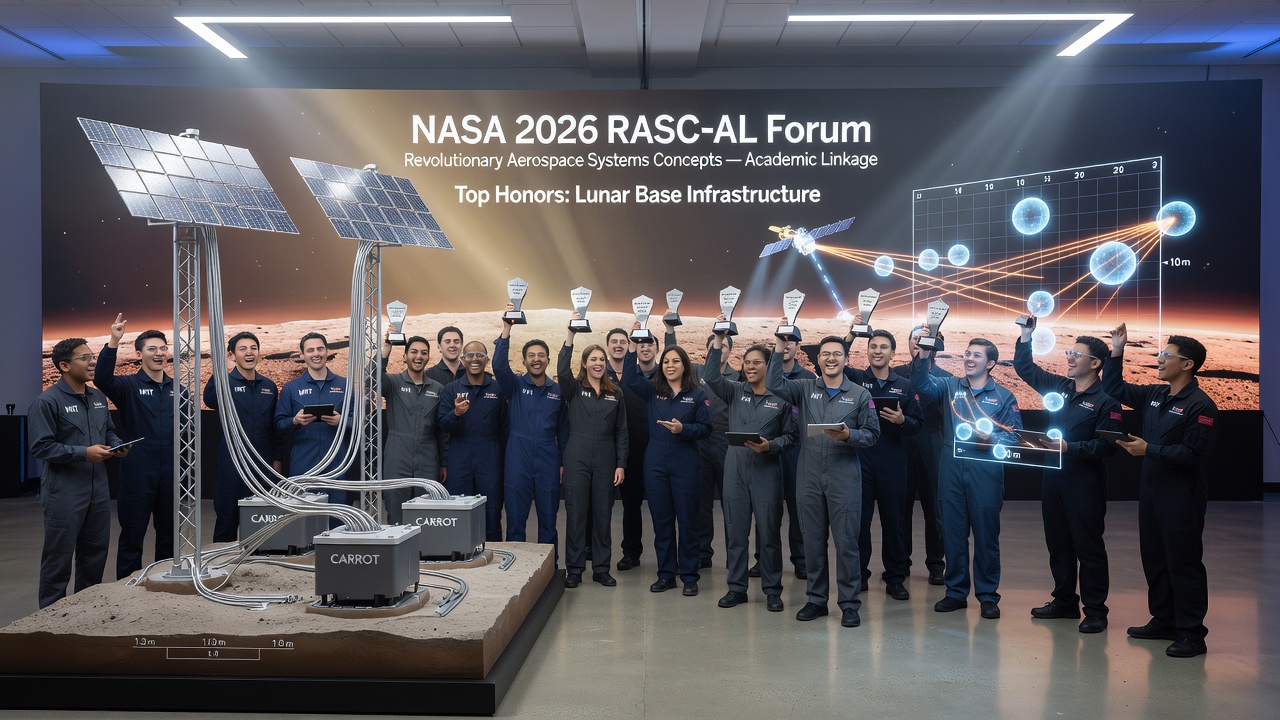
MIT Student Teams Win Top Honors in NASA Competition
Three teams of MIT students, comprising 35 members from eight departments and Wellesley College, have earned top honors at NASA’s 2026 Revolutionary Aerospace Systems Concepts — Academic Linkage (RASC-AL) Forum. Their designs for critical early infrastructure for a permanent lunar base took first and second place overall, along with three best-in-theme awards, among 75 submissions and 14 finalists.
Powering the Moon: ECLIPSE Wins First Place
The Exploration-Class Lunar Integrated Power SystEm (ECLIPSE) team secured first place overall and first in its lunar surface power theme category. The design addresses the moon base’s most demanding constraint: surviving the 18-day lunar night and winter. ECLIPSE pairs 20-meter solar masts with buried 20-kilowatt microreactors named CARROT, engineered for more than 99.995 percent uptime—under 27 minutes of downtime per year. The microreactors, buried 1.3 meters deep, dramatically shrink safety zones and reduce shielding mass. A grid of aluminum cables and shielded DC equipment delivers an initial 120 kilowatts, with laser-equipped rovers providing up to 10 kilowatts to remote sites. The team prioritized reliability over mass, ensuring the system can scale from six astronauts to industrial demand.
Communications and Navigation: MELIORA Takes Second Place
The MELIORA team won second place overall and first in the Mars communications, position navigation, and timing category, with a strategy to validate the design at the moon before extending to Mars. By analyzing 5,764 candidate constellation geometries, the team developed a system that grows from three to 23 satellites, returns over 100 megabits per second via free-space optical links, and pinpoints users to within 10 meters. For Mars, four relay satellites at Lagrange points maintain communication even during solar conjunction. “You should never have to think about whether the network is there—it just is,” said co-lead Ekaterina Tiukhtikova, an undergraduate in AeroAstro and EECS.
Living Off the Land: CHEESEBURGER Wins Best-in-Theme
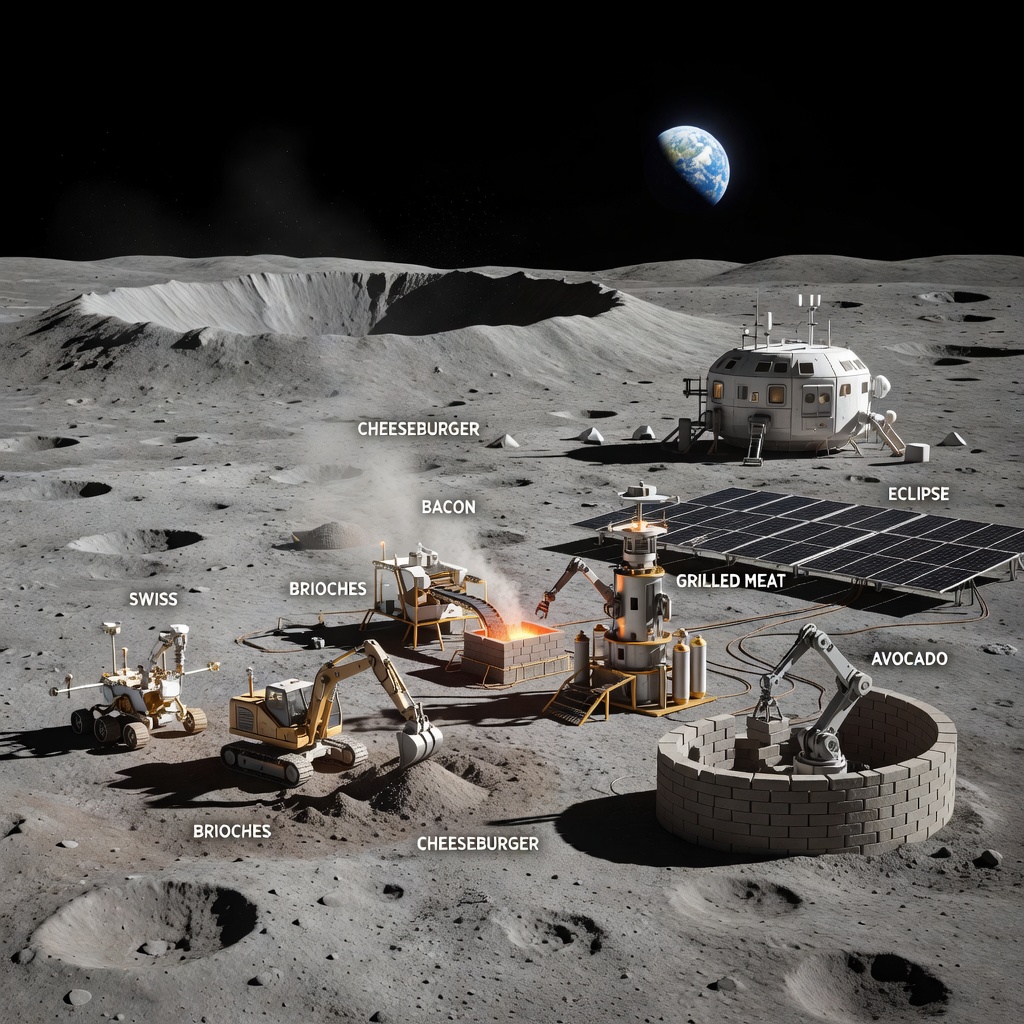
The CHEESEBURGER campaign, named after the team’s January outing in Sandwich, Massachusetts, won first in its lunar technology demonstrations category. It outlines five robotic payloads—SWISS, BRIOCHES, BACON, GRILLED MEAT, and AVOCADO—that prospect, dig, sort, cast bricks, extract metal and oxygen, and stack structures from lunar regolith. The goal is to prove an end-to-end supply chain for oxygen, metals, and radiation shielding, all while making acronyms memorable.
Interdisciplinary Collaboration and NASA’s Lunar Vision
Students from AeroAstro, System Design and Management, Nuclear Science and Engineering, EECS, Mechanical Engineering, the Technology and Policy Program, MIT Sloan, and Earth, Atmospheric and Planetary Sciences, plus a Wellesley student, collaborated across teams. Advisors included Olivier de Weck, Kerri Cahoy, Jeffrey Hoffman, Koroush Shirvan, and George Lordos. The integrated designs—ECLIPSE’s grid powers CHEESEBURGER’s processing, which in turn shields the grid—are timed for NASA’s goal of astronauts living on the lunar surface for months by the early 2030s. As de Weck noted, “A permanent base is no longer a slide in a strategy deck; NASA begins landing the first elements in 2027.” The RASC-AL Forum, administered by the National Institute of Aerospace, recognized the work as crucial for shaping the Artemis mission’s infrastructure.
The source for this article is https://news.mit.edu/2026/interdisciplinary-mit-teams-win-top-honors-nasa-competition-0630.