
Nanoscale Sensors Could Help Solve Robotics’ Tactile Sensing Challenge
As artificial intelligence and robotics advance at breakneck speed, the industry’s focus has largely centered on software, large language models, and ever-more-powerful processors. Yet for robots to operate effectively in the physical world, a more fundamental capability remains elusive: the ability to sense and interpret their surroundings.
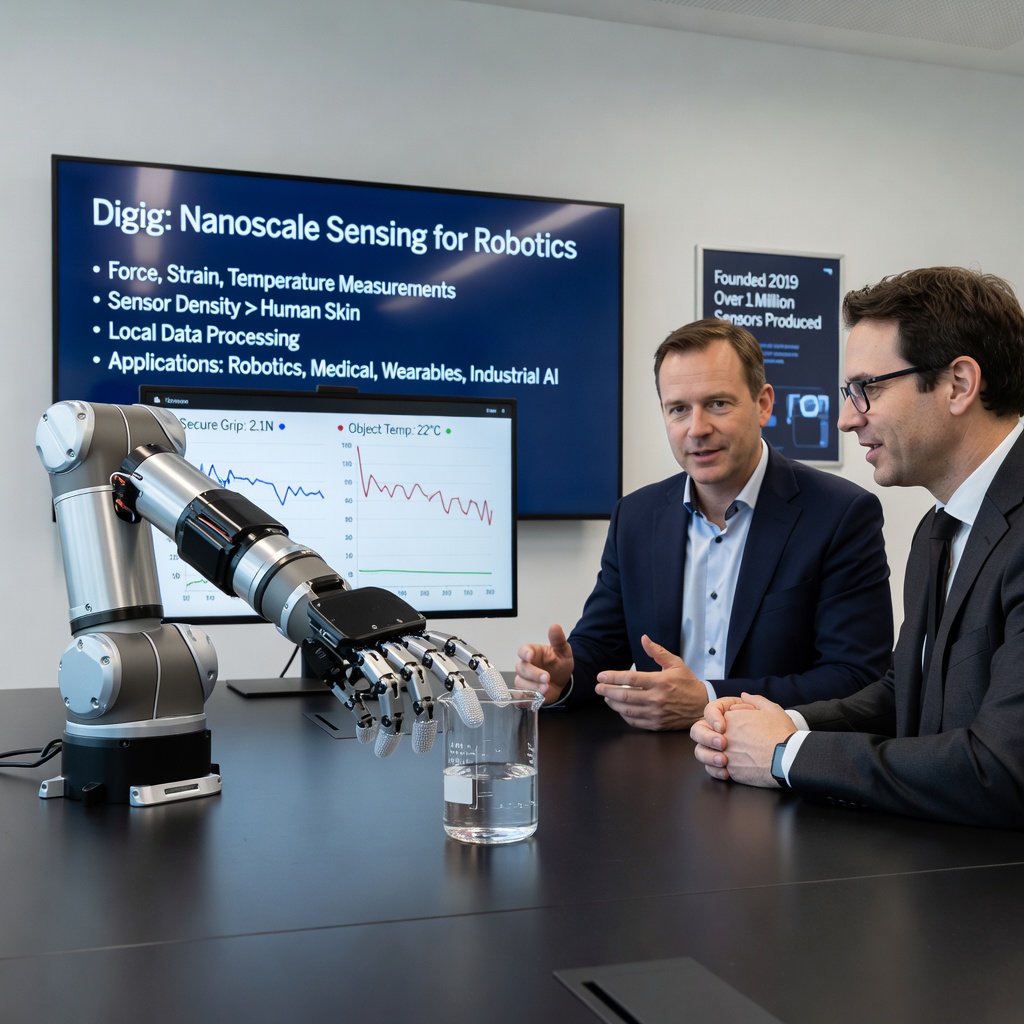
That challenge is fueling interest in advanced sensing technologies, and one company aiming to fill the gap is Digid, a Germany-based developer of nanoscale sensors for force, temperature, and other measurements. Its sensors are small enough to be integrated directly onto customer products and components, enabling measurements in locations where conventional sensors cannot fit. Since its founding in 2019, Digid has industrialized its nanosensor technology, producing more than one million sensors for applications spanning robotics, medical devices, wearables, industrial systems, and AI infrastructure.
In an interview with Robotics & Automation News, Nils Könne, head of product, and Christian Kreil, head of business development, discussed how their technology could address one of robotics’ most persistent challenges: tactile sensing.
The Tactile Sensing Challenge
“Tactile sensing remains one of the major challenges in robotics,” Könne said. “Our sensors can be used to create robotic skin and highly sensitive fingertips with sensor densities far beyond those found in human skin.”
He noted that the goal is not necessarily to match every biological function, but to provide robots with richer information about the objects and environments they interact with. Today’s robots rely heavily on vision, but when a robot picks up an object, it also needs to know how much force it is applying, whether the object is slipping, and how conditions are changing during the interaction.
“The better a robot can perceive the physical world, the more capable it becomes,” Könne added.
Digid’s sensors measure force, strain, and temperature simultaneously, and because they add only a few micrometers to a surface, they can be placed directly onto a customer’s device without requiring major design changes.
Addressing the Data Problem
If robots were covered in thousands of sensors, data overload could become a significant issue. Könne acknowledged the challenge, emphasizing that local processing is essential.
“The solution is not to send every sensor reading to the cloud. Data needs to be processed locally so that only relevant information reaches higher-level systems,” he explained. “For example, when a robot picks up a cup, the important question is whether the grip is secure, not the raw output from every sensor.”
He said local preprocessing will become critical as tactile sensing becomes more sophisticated.
Commercial Interest and Applications
Digid works with customers ranging from startups to Fortune 500 companies. According to Kreil, the strongest interest today comes from robotics, wearables, medical devices, industrial sensing, and human-machine interfaces.
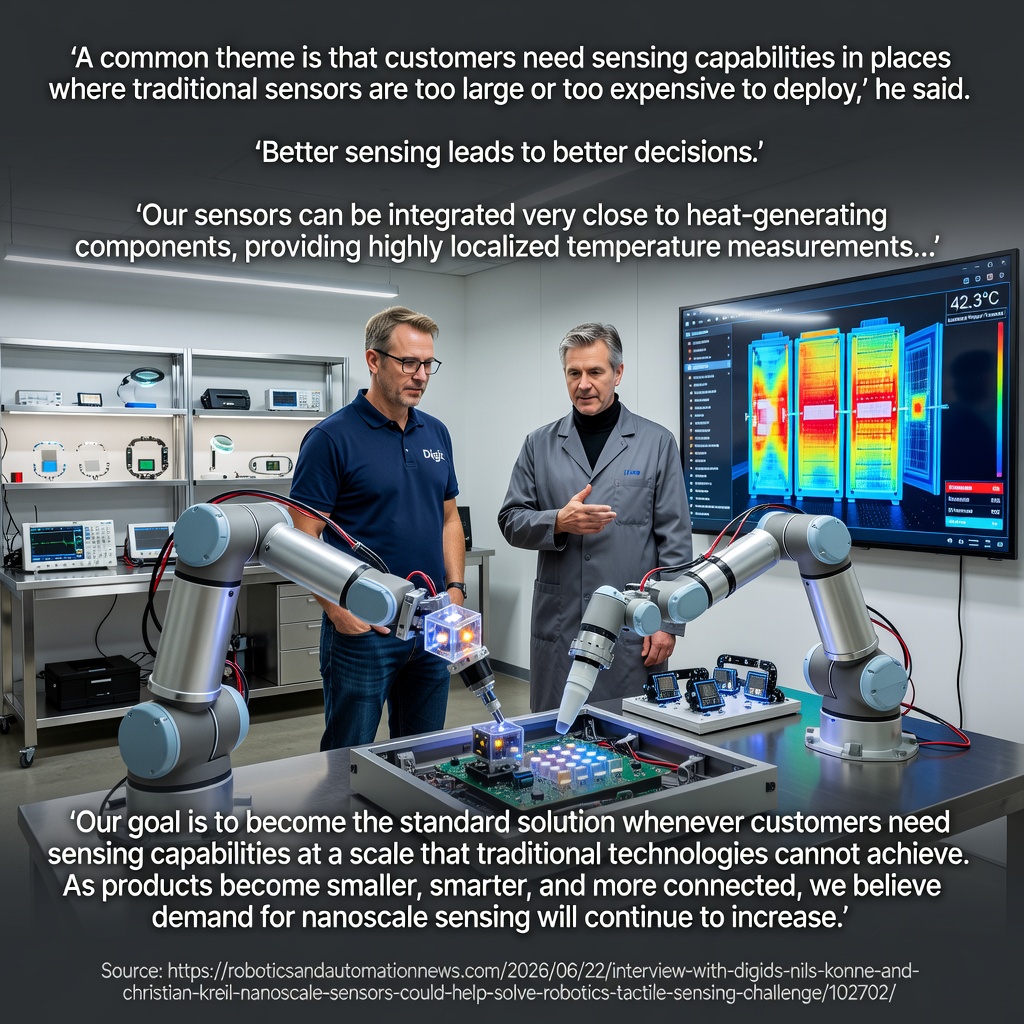
“A common theme is that customers need sensing capabilities in places where traditional sensors are too large or too expensive to deploy,” he said.
Since exhibiting at CES, the company has seen growing interest from large firms looking for force and temperature measurements in locations where existing technologies simply do not fit, Könne added.
The company’s technology has already proven its value: one project allowed Digid to reduce a customer’s pressure-sensing system from approximately 30 components down to six, cutting complexity, manufacturing effort, and cost.
Expanding into AI Infrastructure
Digid has also found a niche in AI infrastructure. Data centers generate enormous amounts of heat, and managing that heat efficiently is becoming increasingly important.
“Our sensors can be integrated very close to heat-generating components, providing highly localized temperature measurements and allowing operators to understand thermal behavior in much greater detail,” Kreil said.
Könne noted that the principle remains the same across domains: “Better sensing leads to better decisions.”
Company Evolution and Future Outlook
Digid began with a strong focus on diagnostics and BioMEMS technology before expanding into industrial sensing and robotics over the past two years. Today the company has around 30 employees, is generating revenue, and is working toward becoming fully self-sustaining.
“We believe we’re still at the beginning,” Kreil said. “Customers regularly approach us with applications we had never considered. Demand for more accurate information from the physical world continues to grow across robotics, healthcare, industrial automation, wearables, and AI infrastructure.”
Könne added: “Our goal is to become the standard solution whenever customers need sensing capabilities at a scale that traditional technologies cannot achieve. As products become smaller, smarter, and more connected, we believe demand for nanoscale sensing will continue to increase.”
The source for this article is https://roboticsandautomationnews.com/2026/06/22/interview-with-digids-nils-konne-and-christian-kreil-nanoscale-sensors-could-help-solve-robotics-tactile-sensing-challenge/102702/.