
New flapping robot swims and flies like a diving bird
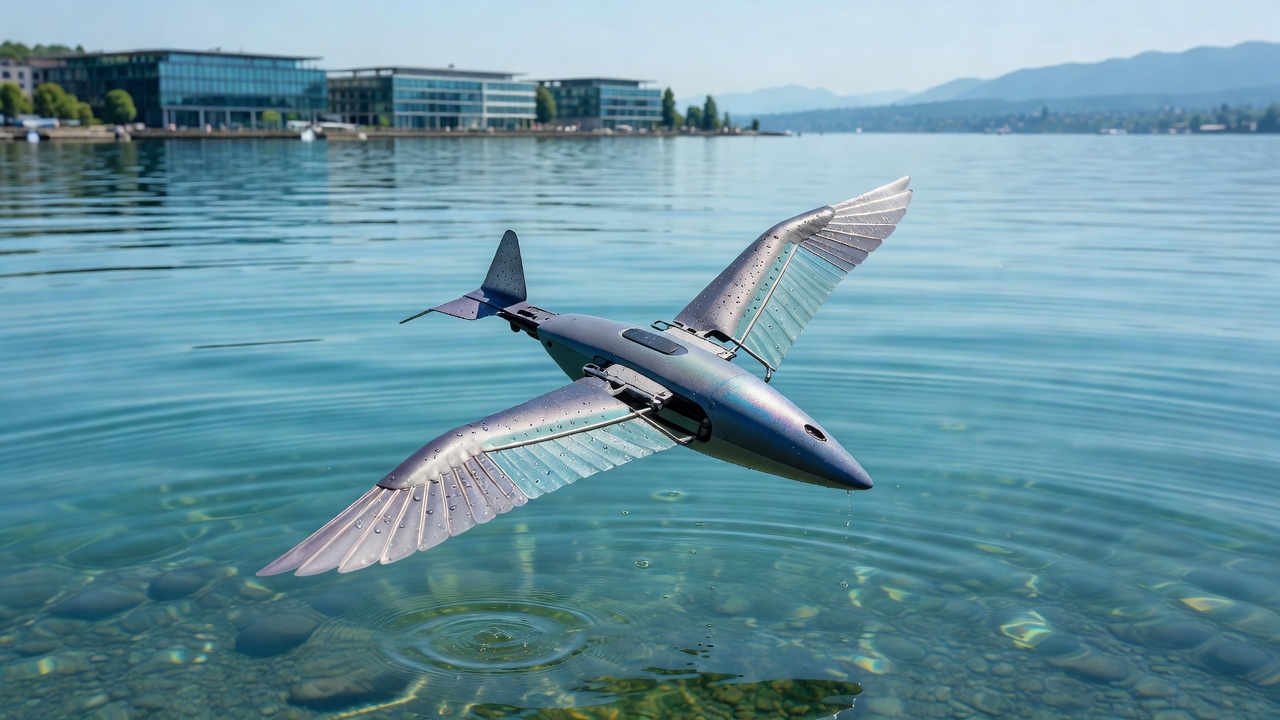
Inspired by loons, puffins, and other diving birds that seamlessly transition between air and water, engineers at MIT and EPFL in Lausanne, Switzerland, have developed a lightweight robot capable of both underwater swimming and aerial flight. The “flapping-wing aerial-aquatic vehicle,” or FAAV, weighs less than 300 grams—roughly half a pound—and is designed to replicate the dual-environment locomotion seen in nature.
The robot features a central fuselage, flexible flapping wings, and a steerable tail, with interchangeable components that allow researchers to experiment with different sizes and configurations. The team’s findings, published today in the journal Science, could shed light on how diving birds adapt their flight mechanics to mediums with vastly different densities, while also paving the way for a new class of amphibious drones.
Design inspired by bird biomechanics
To engineer a craft that could operate in both air and water, the researchers first analyzed scientific data on puffins, petrels, kingfishers, and other diving birds. They noted that smaller birds flap their wings about 10 times per second in air and four times per second underwater, with larger birds exhibiting slightly lower frequencies due to wider wingspans.
The resulting robot mimics these frequencies. Its body houses a waterproof electric motor and battery that drive a crankshaft, moving the wings up and down at preset rates. The wings are made of thin hydrophobic membranes to repel water, and the motorized tail can adjust its angle to control ascent or descent. The team fabricated three sets of wings—small (60 cm), medium (80 cm), and large (100 cm)—to test performance.
Testing transitions from water to air
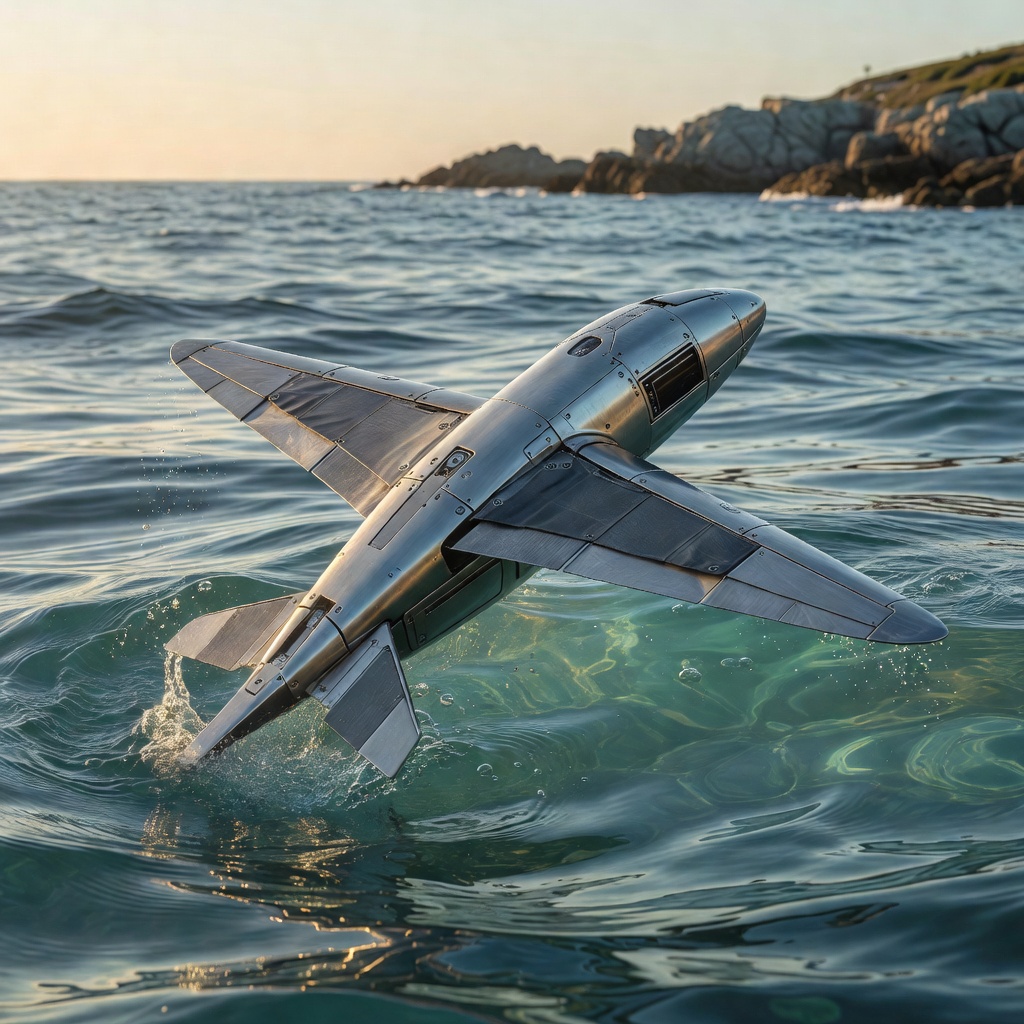
Experiments were conducted in a water tank and later in Lake Geneva, Switzerland. The robot was placed about half a meter underwater and programmed to flap at various frequencies while the tail pitched at specific angles. Researchers observed which combinations allowed the craft to swim upward, break the surface, and continue flying.
The most successful configuration used medium-sized wings, with the robot swimming underwater at nearly 1 meter per second at around 5 flaps per second, and flying through air at about 6 meters per second at a similar flapping rate. To launch from water into air, the robot needed to pitch at a 70-degree angle—steep enough to keep wingtips from touching the surface. “Flexibility is key,” notes lead author Raphael Zufferey, assistant professor of mechanical engineering at MIT. “The wings need to be flexible enough to minimize flapping amplitude in water and firm enough to keep the robot aloft in the air.”
Surprisingly, the robot did not require a paddling motion, which many diving birds use during takeoff. “If you look at birds, most birds need to paddle at the surface to take off,” Zufferey says. “And the question was, do we need the same for robots? And it turns out we don’t.”
Future applications for ocean science
The team envisions the FAAV being deployed for oceanography, where it could fly to sampling sites, dive for measurements, and return with data—all at a fraction of the cost of traditional vessel-based methods. “You could send this out not just every week, but every hour,” Zufferey explains. “It could fly out at high speeds, dive in, fly back, deliver its data, and go back out, multiple times.”
Future work will focus on enabling the wings to turn, testing performance in turbulent winds and choppy waters, and ultimately deploying the robot to assist marine biologists and coastal communities. The research was supported in part by a Marie Skłodowska-Curie Actions fellowship grant.
The source for this article is https://news.mit.edu/2026/new-flapping-robot-swims-and-flies-like-diving-bird-0709.