
NVIDIA and Hugging Face Bring New Models and Frameworks to LeRobot for the Open Robotics Community
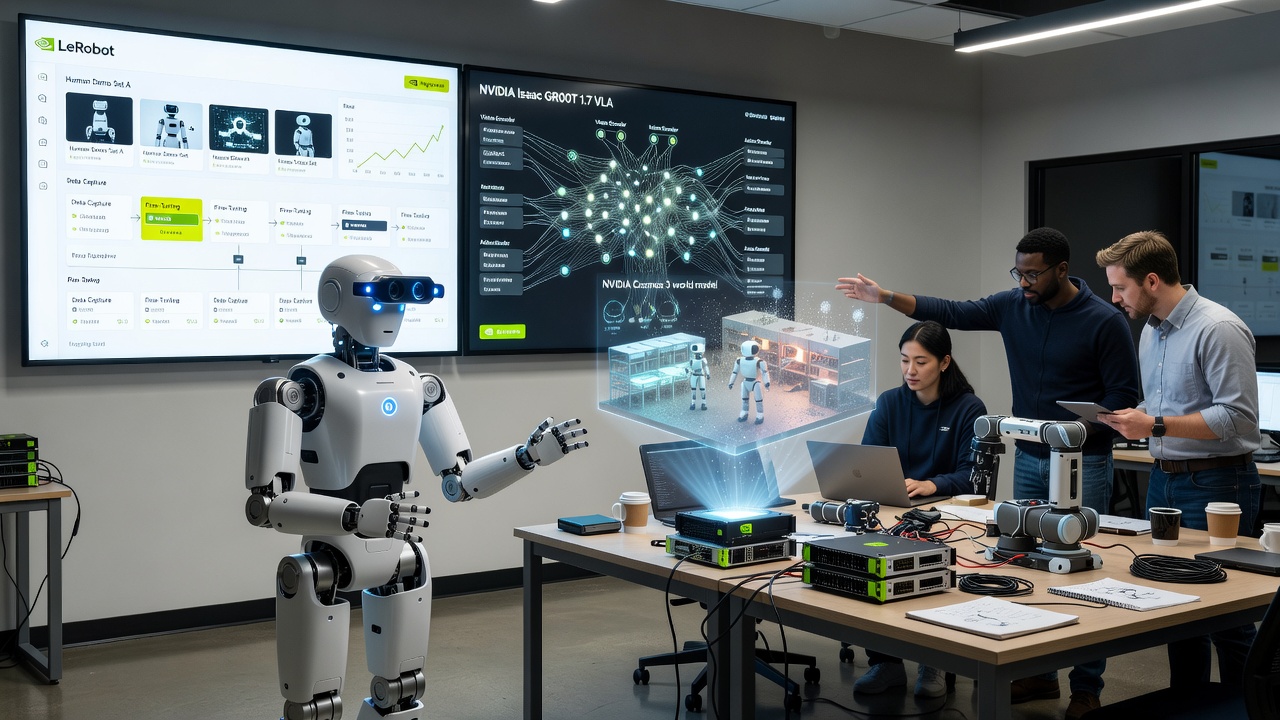
NVIDIA and Hugging Face are partnering to integrate key NVIDIA robotics technologies into LeRobot, Hugging Face’s open‑source robotics library. The collaboration brings the NVIDIA Isaac GR00T 1.7 reasoning vision‑language‑action (VLA) model for humanoid robots and the NVIDIA Isaac Teleop framework to LeRobot, with plans to add the NVIDIA Cosmos 3 world model for physical AI. These integrations aim to lower barriers to robot development by providing shared models, data, and workflows, fostering innovation within the open robotics community.
“Open source is how a field turns advanced research into something people can study, adapt and build on,” said Thomas Wolf, cofounder and chief science officer at Hugging Face. “With NVIDIA Isaac GR00T 1.7 and Isaac TeleOp in LeRobot today, robotics developers can use shared models, data and workflows to train and evaluate robots in the open. And with NVIDIA Cosmos 3 planned next, the community will have a path to bring frontier world models into that same collaborative loop.”
Open Pipeline for Robot Foundation Models
LeRobot serves as a central hub for training, running, and sharing robot datasets, models, policies, and workflows. By embedding NVIDIA’s physical AI capabilities into LeRobot, developers gain a standardized approach to data collection, model fine‑tuning, performance evaluation, and deployment. The new additions include:
- NVIDIA Isaac Teleop: An open‑source framework that helps developers capture high‑quality human demonstrations from external devices in standardized, interoperable formats. This data can then be expanded and shared directly within LeRobot.
- NVIDIA Isaac GR00T 1.7: The first open and commercially viable robot foundation model, now post‑trainable and deployable through LeRobot workflows. Developers can adapt GR00T to new robot embodiments and tasks with benchmarked performance.
- NVIDIA Cosmos 3: A frontier world foundation model for physical AI, coming soon to LeRobot. It will enable generation and augmentation of robotics data, simulation of scenarios, and policy development when real‑world data is limited or costly.
Additional Resources and Community Impact
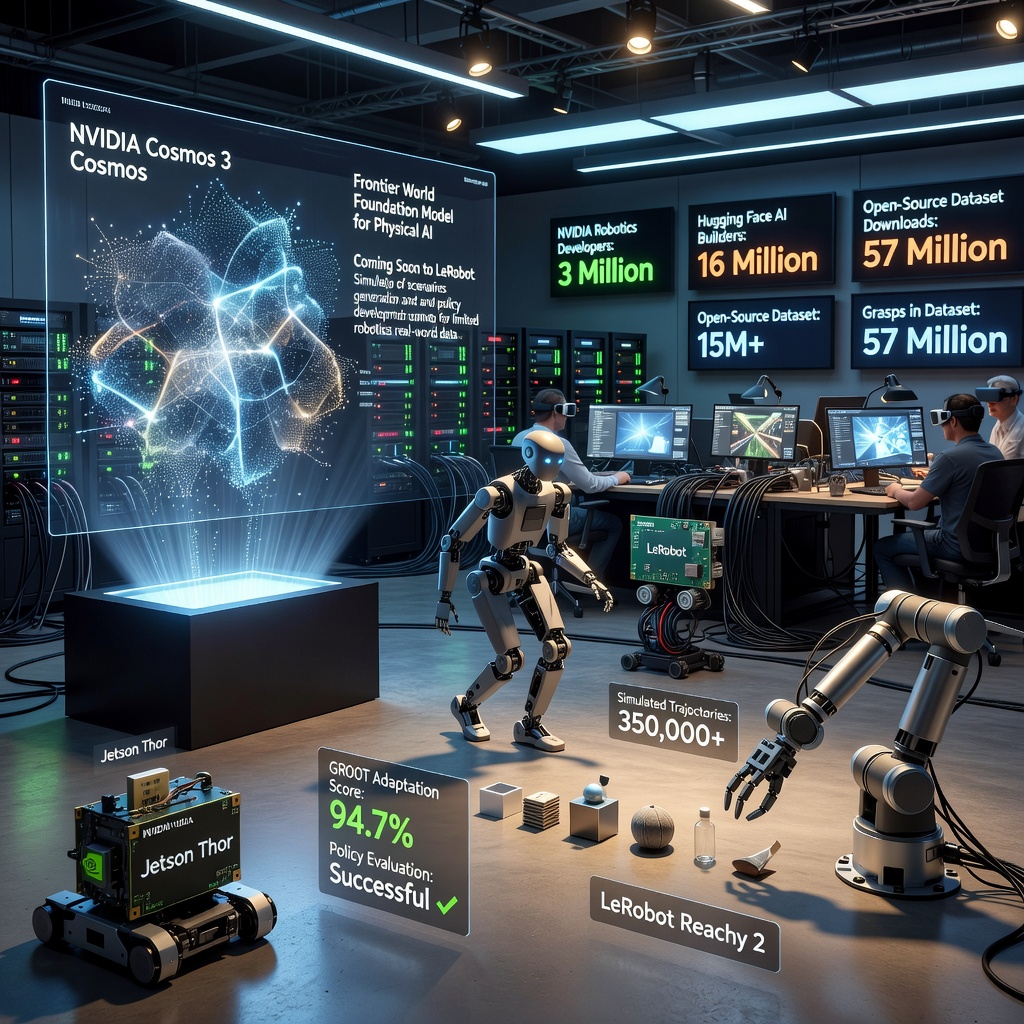
These integrations build on existing NVIDIA resources already connected to LeRobot. Notable assets include the largest open‑source physical AI dataset—downloaded over 15 million times and containing more than 350,000 real and simulated trajectories and 57 million grasps—as well as simulation frameworks based on NVIDIA Isaac Sim and Isaac Lab. The newly introduced NVIDIA Isaac Lab‑Arena in the LeRobot Environment Hub allows developers to quickly prototype complex simulation environments, register them in LeRobot EnvHub, and seamlessly train and evaluate generalist policies such as GR00T, Pi, and SmolVLA. Additionally, integration of NVIDIA Jetson Thor with LeRobot’s Reachy 2 supports deployment of VLA models on open‑source humanoid robots.
By connecting NVIDIA’s 3 million robotics developers with Hugging Face’s 16 million AI builders, the partnership expands access to frontier physical AI tools through open workflows, driving collaboration and accelerating progress across the entire open robotics ecosystem.
The source for this article is https://www.roboticstomorrow.com/news/2026/07/07/nvidia-and-hugging-face-bring-new-models-and-frameworks-to-lerobot-for-the-open-robotics-community/26816/.