
NVIDIA Introduces RoboLab to Tackle Robot Policy Evaluation Challenges
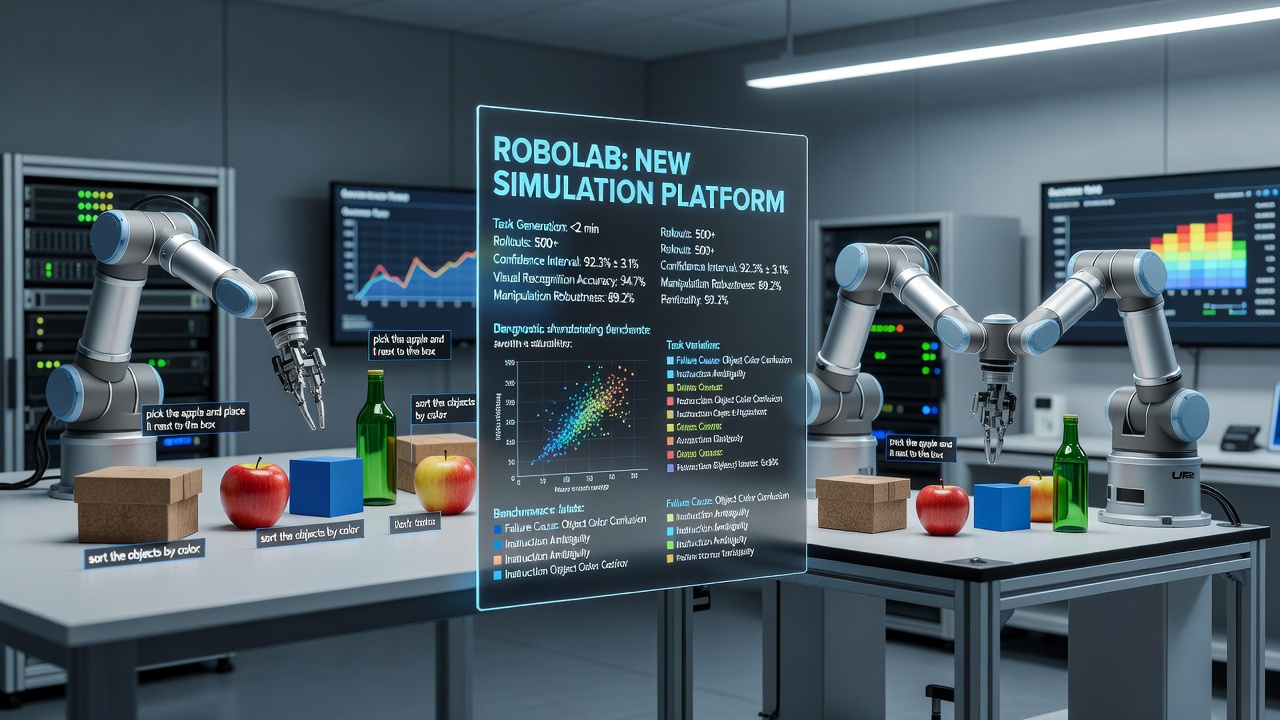
Robotics foundation models have made remarkable progress, with today’s best systems capable of following natural language instructions to pick, place, sort, and manipulate a wide variety of objects. However, as these models grow more capable, evaluating them rigorously has become one of the field’s hardest unsolved problems. NVIDIA has identified critical shortcomings in current benchmarks and introduced a new simulation platform, RoboLab, to address them.
Why Current Benchmarks Fall Short
NVIDIA outlines several key issues with existing robot evaluation methods. Real-world testing is expensive, slow, and difficult to reproduce, making simulation the natural alternative. Yet most simulated benchmarks suffer from visual domain overlap, where training and evaluation data come from the same source, meaning strong performance may only indicate that the model memorized the setup rather than genuinely generalizing.
Another problem is benchmark saturation. Most benchmarks have a fixed task set that is rarely updated, leading to performance ceilings where every system reports over 90% success, making it impossible to distinguish truly capable models. Additionally, binary success/failure scores offer little diagnostic value—they do not explain why a robot failed, whether due to object color, instruction phrasing, or camera shifts.
Statistical trustworthiness is also a concern. A single success rate from a small number of rollouts can be misleading. For example, an observed 90% success rate with just 70 rollouts yields a 95% confidence interval spanning 80.5% to 95.9%. Most published benchmarks do not run enough rollouts to achieve statistical significance when comparing policy performance.
Introducing RoboLab: A New Benchmarking Platform
To overcome these challenges, NVIDIA has built RoboLab, a simulation benchmarking platform based on three principles:
- Enable robot-agnostic evaluations with meaningful metrics
- Allow rapid generation of new tasks to avoid saturation, with support for agentic AI workflows
- Provide a full suite of analysis tools to understand policy performance, failures, and causes
RoboLab mirrors real-world setup: users place objects, add language instructions, and run a policy. Task generation takes only minutes, and agentic skills allow coding agents to create novel tasks directly in a user’s workflow, future-proofing the benchmark.
Bring Your Own Robot and Capability-Specific Tasks
A key feature of RoboLab is that tasks are robot- and policy-agnostic. The same tasks can be evaluated regardless of robot embodiment or policy architecture, allowing users to bring their own robots. This is increasingly important as the diversity of robot platforms grows.
RoboLab also organizes tasks by capability, targeting three distinct competencies: visual (recognizing color, size, category), procedural (action-oriented reasoning like stacking), and relational (spatial and linguistic logic). The initial benchmark, RoboLab-120, includes 120 human-curated tabletop pick-and-place tasks, each tagged with the capabilities it requires to ensure balanced coverage.
Beyond Binary Success: Graded Metrics and Diagnostic Tools
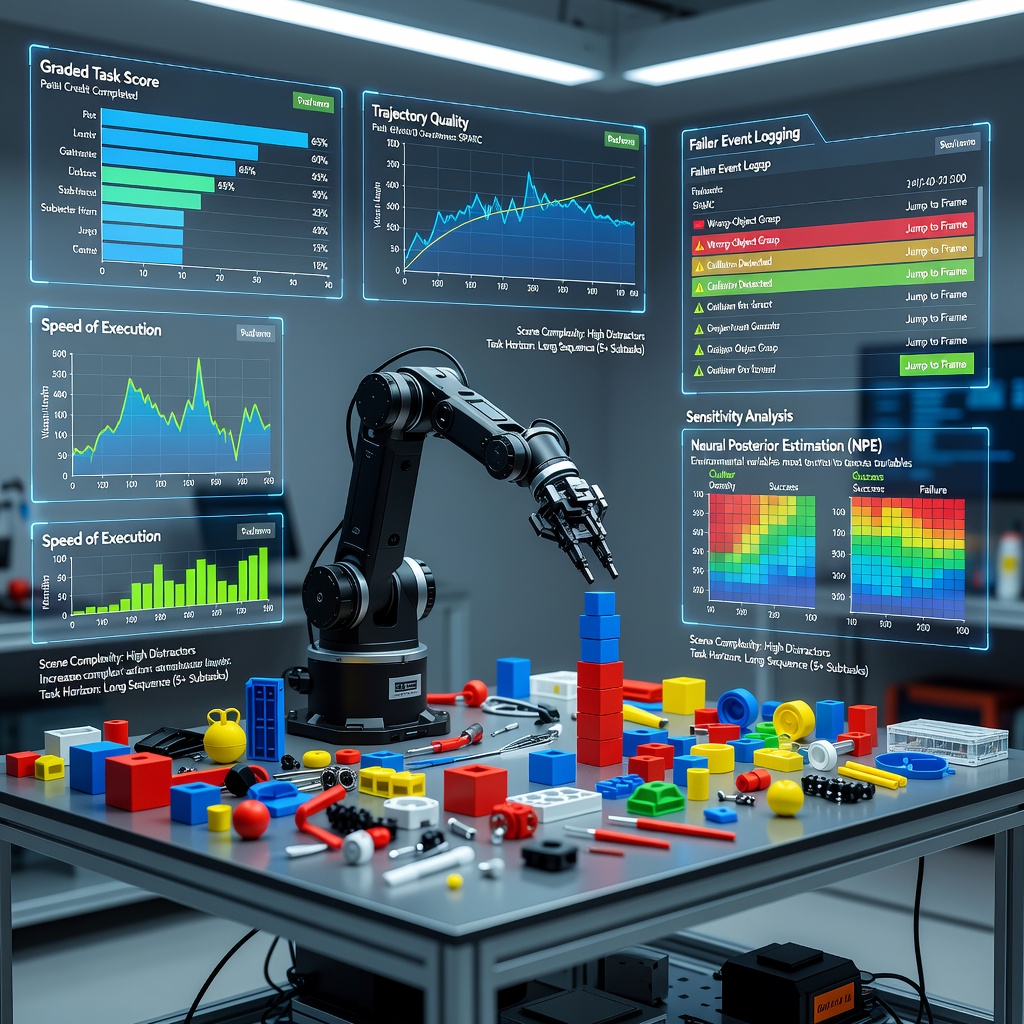
NVIDIA argues that success rate alone is insufficient. RoboLab introduces three additional metrics:
- Graded task scores that give partial credit for completing subtasks
- Trajectory quality measured via path length and SPARC (spectral arc-length) for smoothness
- Speed of execution measured by end effector velocity
For diagnosis, RoboLab includes failure event logging that automatically tracks wrong-object grasps, dropped objects, and collisions. A built-in dashboard surfaces events as they happen, allowing users to jump to the exact frame where a failure occurred. This turns diagnosis from guesswork into a debugging-like process.
Testing Robustness Against Complexity and Sensitivity
Real-world deployment rarely offers clean conditions. RoboLab analyzes performance against increasing language complexity (vague, default, specific instructions), scene complexity (distractors and clutter), and task horizon (short vs. long sequences). NVIDIA found that most policies struggle with long-horizon tasks, with none able to perform more than four complex subtasks successfully.
To handle the intractability of testing every environmental variable in isolation, RoboLab applies sensitivity analysis using Neural Posterior Estimation (NPE). This method identifies which environmental conditions are most associated with success or failure, turning intuitions into quantified findings.
Why It Matters
Robotics benchmarking still lags behind other areas of AI research. Without a field-standard platform, measuring progress is difficult. As policies become more capable, success rates alone will not reveal whether a model truly generalizes or merely memorized test conditions. NVIDIA’s RoboLab aims to establish a scalable path toward diagnostic robot evaluation, using simulation to provide meaningful, actionable insights for researchers and practitioners.
Xuning Yang, senior research scientist at NVIDIA’s Seattle Research Lab and author of the work, notes that the platform is designed to evolve as fast as the models it measures, with benchmarks that expand rather than saturate and metrics that diagnose rather than simply score.
The source for this article is https://www.therobotreport.com/nvidia-shares-how-evaluate-general-purpose-robot-policies-real-world-deployment/.