
NVIDIA Launches Isaac GR00T Platform to Streamline Humanoid Robot Development
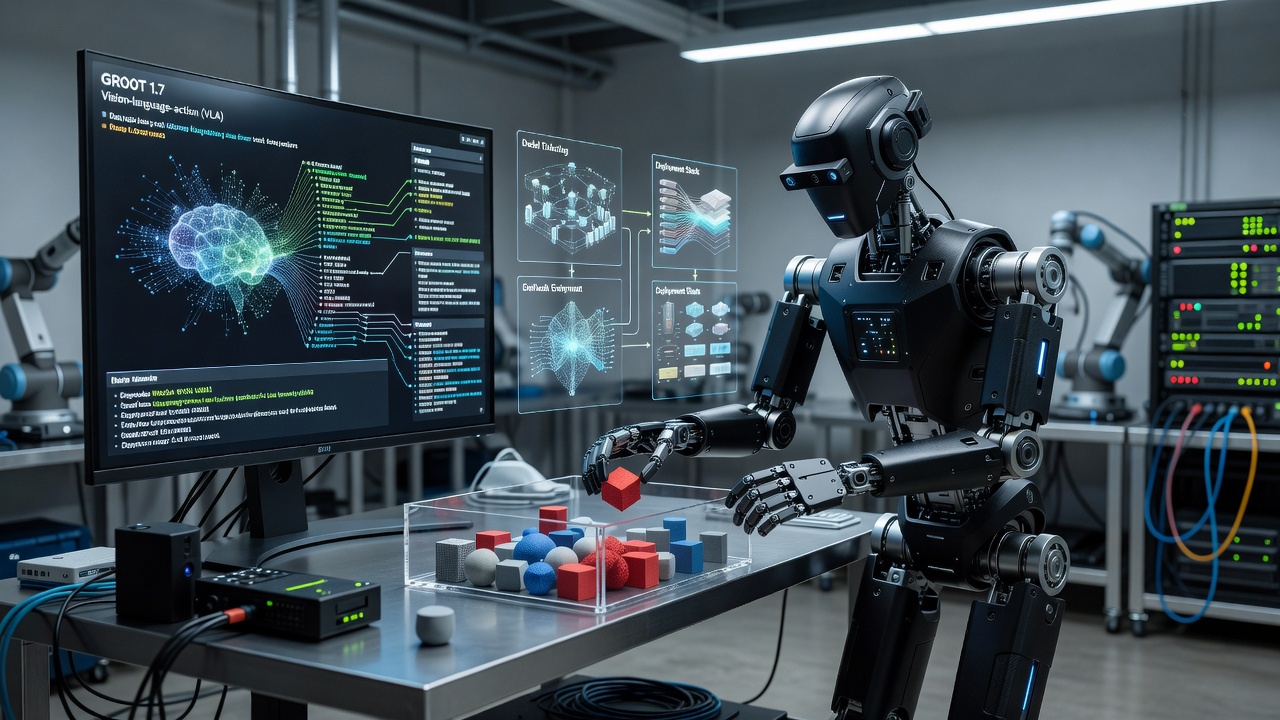
NVIDIA has introduced the Isaac GR00T Development Platform, an open-source solution designed to address the fragmentation and complexity that has long hampered humanoid robot development. The platform aims to provide a seamless, end-to-end workflow covering data collection, model training, evaluation, and deployment—allowing developers to move from robot bring-up to task-specific skill development without the burden of configuring disparate tools.
The humanoid robotics ecosystem currently suffers from siloed software, incompatible data formats, and manual integrations between stages of the development pipeline. NVIDIA’s new platform solves this by offering a fully integrated, modular framework. Teams can adopt individual components or leverage the complete pipeline, integrate their own tooling, and build on a validated NVIDIA software stack.
GR00T 1.7 Model: Key Enhancements
A central component of the platform is the Isaac GR00T 1.7 vision-language-action (VLA) model—the first open, commercially usable VLA model for generalized humanoid robot skills, released under the permissive Apache 2.0 license. With 3 billion parameters, the model accepts multimodal input including language and images and outputs actions for diverse tasks across varied environments.
Key improvements in version 1.7 include robust human video pretraining on approximately 32,000 hours of real demonstration and human ego-centric data, plus 8,000 hours of simulated data from BEHAVIOR, RoboCasa, and Simulated GR-1. The new Cosmos-Reason2-2B visual language model backbone replaces the earlier Eagle backbone, supporting flexible resolution and native aspect ratio encoding without padding.
Model performance has been significantly enhanced through long-horizon task reasoning with task- and subtask-level decomposition. Benchmark results show consistent improvements over the N1.6 version, including a 10% gain on DROID-F0, 61% on DROID-F6, and modest improvements on SimplerEnv benchmarks. Expanded deployment support now includes full pipeline export to ONNX and TensorRT with higher-frequency updates.
The model weights are publicly accessible via GitHub and Hugging Face.
End-to-End Workflow in Action
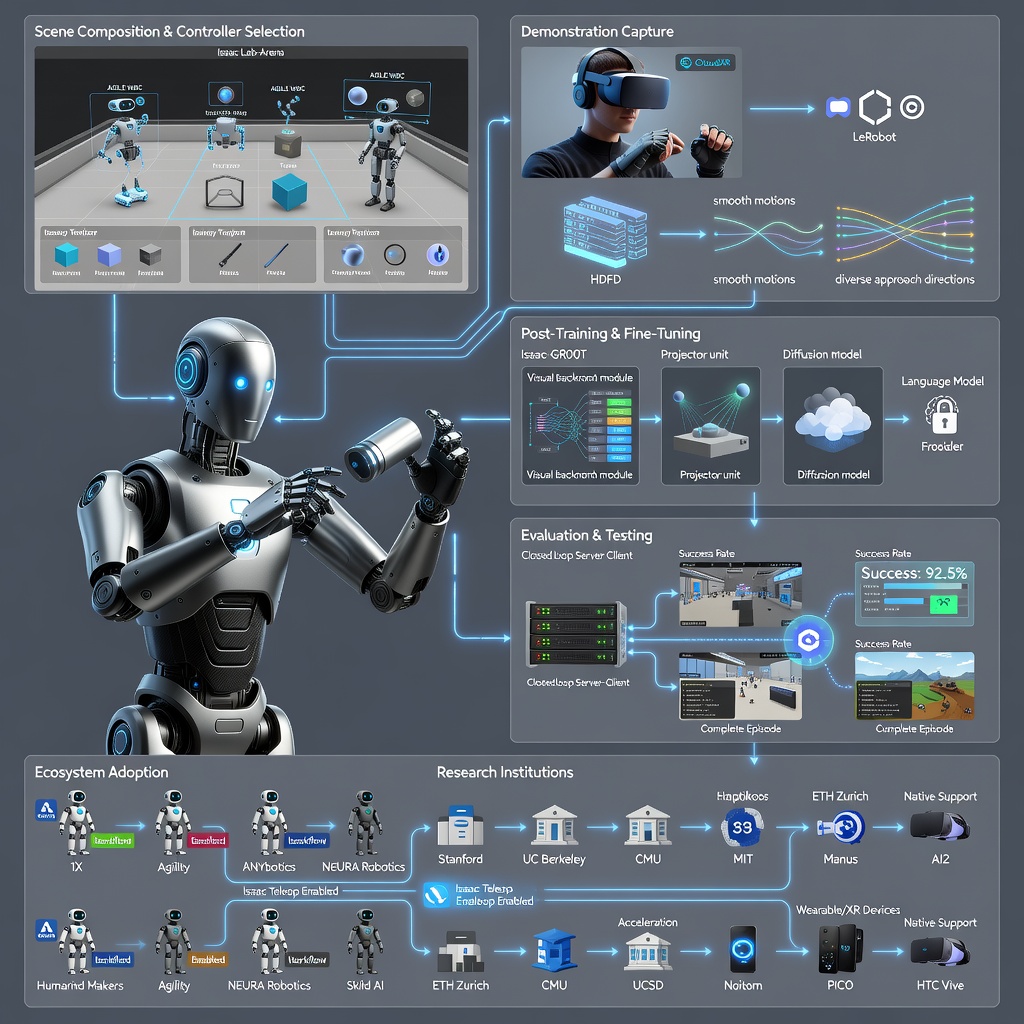
NVIDIA has provided a detailed walkthrough of the platform using a pick-and-place task in simulation. The process begins with environment setup using Isaac Lab-Arena APIs to compose scenes with robot and object assets. Developers select a whole-body controller—such as AGILE WBC for static tasks—which directly influences the training signal during teleoperation.
Demonstrations are captured using Isaac Teleop with VR headset support over CloudXR. For the example task, 400 clean trajectories were collected, with emphasis on quality: smooth motions, stable grasps, and diverse approach directions. The recorded HDF5 data is then converted to the LeRobot format required by GR00T 1.7 for post-training.
Post-training is performed using a standalone checkout of the Isaac-GR00T repo. The fine-tuning command tunes the visual backbone, projector, and diffusion model while keeping the language model frozen. After training, evaluation runs in a closed-loop server-client setup, with metrics such as success rate printed to the console. Developers can adjust evaluation parameters to test complete episodes across multiple environments for robust performance estimates.
Growing Ecosystem Adoption
The GR00T platform and reference workflow are gaining traction across the humanoid robotics ecosystem. Humanoid makers and AI providers including 1X, Agility, ANYbotics, NEURA Robotics, and Skild AI are integrating components such as Isaac Teleop, Sim, Lab, and ROS to accelerate their development pipelines.
Leading research institutions—Stanford, UC Berkeley, CMU, MIT, UCSD, ETH Zurich, and AI2—will use the unified workflow to reduce integration complexity and move faster from robot bring-up to real-world validation. Additionally, wearable and XR device makers like Haptikos, Manus, Noitom, PICO, and HTC Vive offer devices with native support for NVIDIA Isaac Teleop, simplifying high-quality demonstration capture.
The GR00T platform and GR00T 1.7 model are available today. NVIDIA has also released a complete end-to-end reference guide, "How to Develop and Deploy Humanoid Robots End-to-End with NVIDIA Isaac GR00T," along with a platform introduction video to help developers get started.
The source for this article is https://developer.nvidia.com/blog/develop-humanoid-robot-policies-end-to-end-with-nvidia-isaac-gr00t/.