
NVIDIA Unveils Halos for Robotics: A Full-Stack Safety System for Physical AI
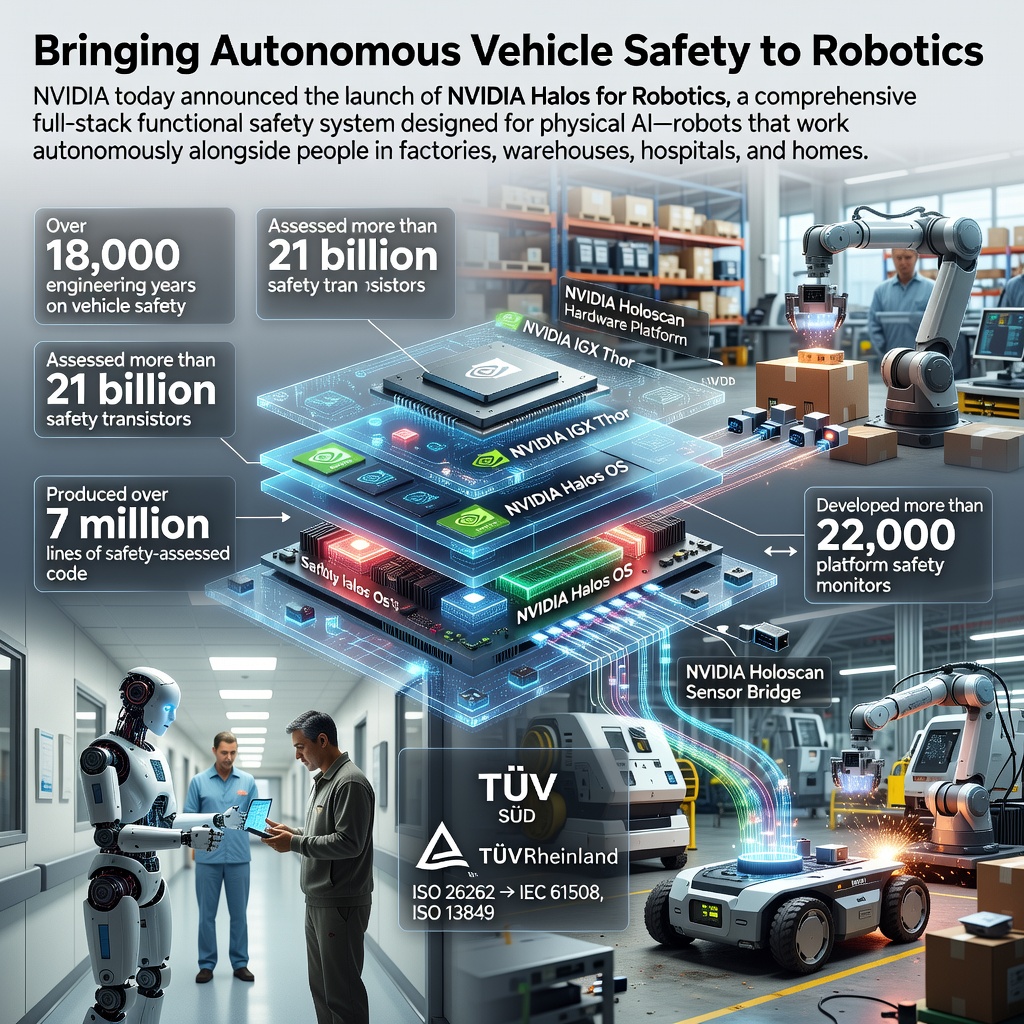
NVIDIA today announced the launch of NVIDIA Halos for Robotics, a comprehensive full-stack functional safety system designed for physical AI—robots that work autonomously alongside people in factories, warehouses, hospitals, and homes. The system combines powerful AI compute with built-in safety, marking a major milestone as robots move out of cages into unstructured environments where traditional safety approaches fall short.
The platform is built on years of NVIDIA investment in autonomous vehicle safety, now extended to industrial robots, humanoids, and autonomous mobile robots. The foundational hardware and software components are NVIDIA IGX Thor and NVIDIA Halos OS.
A Proven Foundation Extended
NVIDIA has accumulated over 18,000 engineering years on vehicle safety, assessed more than 21 billion safety transistors, produced over 7 million lines of safety-assessed code, and developed more than 22,000 platform safety monitors. This work, originally built for one of the most demanding safety domains, is now being applied to robotics without being rebuilt from scratch.
The same safety development processes, tools, and foundational functional safety standards (ISO 26262 → IEC 61508, ISO 13849) are shared across AV and robotics stacks. Third-party assessments by TÜV SÜD and TÜV Rheinland confirm compliance across both domains. NVIDIA is also helping shape future robotics safety standards through its convenorship of IEC 61508 and leadership of ISO/IEC TS 22440.
Hardware and Software Stack
At the base of the Halos stack is the NVIDIA IGX Thor platform, an industrial-grade AI compute module delivering up to 2,070 FP4 TFLOPs of AI performance, 14x Neoverse ARM CPU cores, and 128 GB of memory. Built-in hardware safety features include a dedicated IEC 61508 SIL 3 capable Safety Island, over 22,000 safety mechanisms, diversity and redundancy, and freedom from interference support.
The NVIDIA Holoscan Sensor Bridge extends the safety chain to sensors and actuators over Ethernet, supporting low-latency streaming, scalability to hundreds of sensors, and end-to-end IEC 61508 SIL 2 safety protocols.
Halos OS sits between the hardware and applications, providing certified building blocks. It includes Halos Core—the base safety operating system—and Halos Applications such as the Outside-In Safety Blueprint.
Halos Core and Blueprints
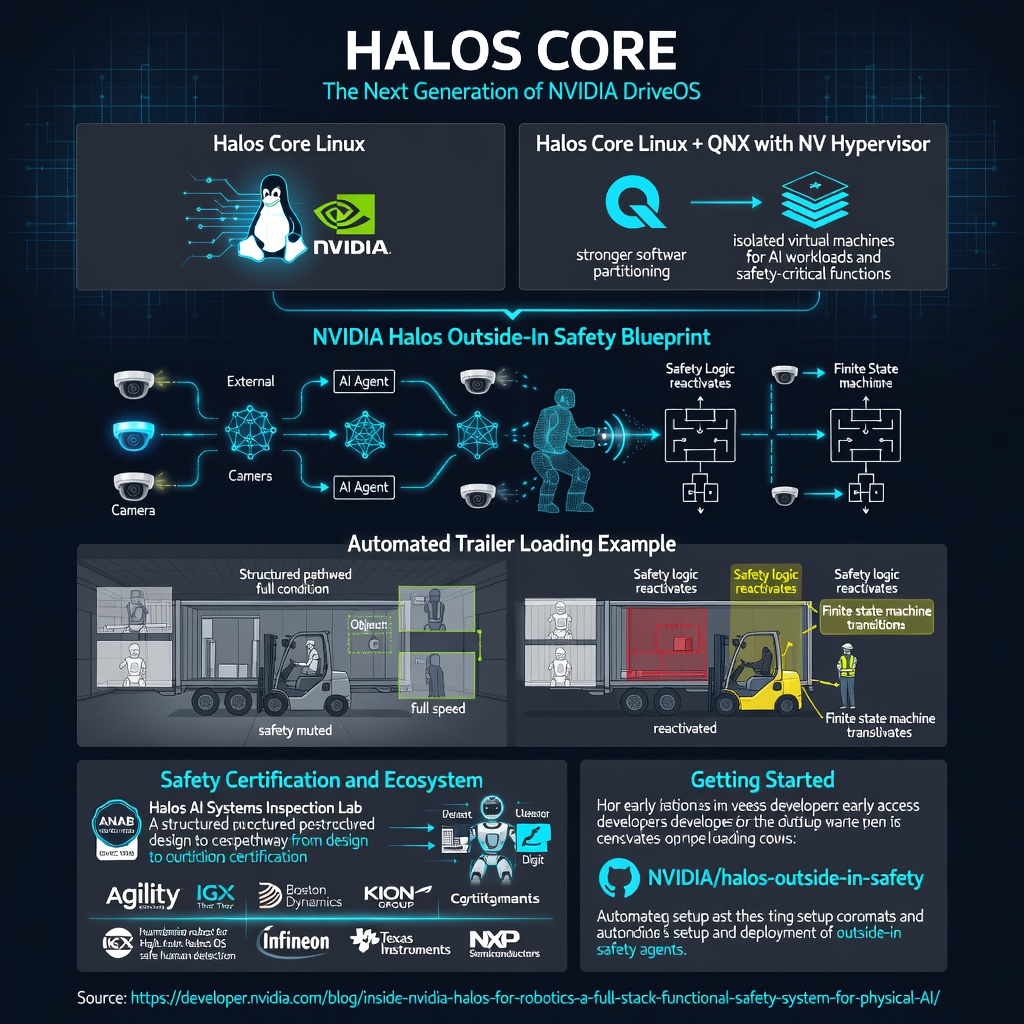
Halos Core, the next generation of NVIDIA DriveOS, comes in two configurations: Halos Core Linux, and Halos Core Linux plus QNX with an NV Hypervisor for stronger software partitioning. The QNX option enables isolated virtual machines for AI workloads and safety-critical functions.
The NVIDIA Halos Outside-In Safety Blueprint extends robot perception using external infrastructure cameras, AI agents, and safety logic to dynamically control robot behavior. It is available as open source and supports AI functional safety standards like ISO/IEC TR 5469 and the upcoming ISO/IEC TS 22440.
Automated Trailer Loading Example
A practical example of the Outside-In Safety Blueprint is automated trailer loading, a common warehouse pain point. The system uses multiple camera streams, object detection and tracking, and a finite state machine on IGX’s dedicated Safety Island to safely mute a forklift’s onboard safety when the area is clear, allowing full-speed operation inside a trailer. The moment a worker enters the loading zone, safety is reactivated. This approach achieves higher throughput without compromising safety.
Safety Certification and Ecosystem
NVIDIA has established the Halos AI Systems Inspection Lab, an ANAB-accredited ISO/IEC 17020 Inspection Body, providing a structured pathway from design to certification. Partners can have their integration inspected against preassessed Halos elements, then take the inspection certificate to third-party agencies like TÜV Rheinland or TÜV SÜD for final certification.
Agility, maker of the humanoid robot Digit, is incorporating NVIDIA IGX Thor and Halos OS into its safe human detection system and has joined the Inspection Lab. The lab’s ecosystem now spans over 43 companies, including Boston Dynamics, KION Group, Infineon, Texas Instruments, and NXP Semiconductors.
Getting Started
NVIDIA Halos Core is available now for early access. Developers can start building outside-in safety agents using the NVIDIA/halos-outside-in-safety GitHub repository, which includes agent skills that automate setup and deployment.
The source for this article is https://developer.nvidia.com/blog/inside-nvidia-halos-for-robotics-a-full-stack-functional-safety-system-for-physical-ai/.