
Oxford Technology Funds Next-Generation Human–Robot Safety Technology
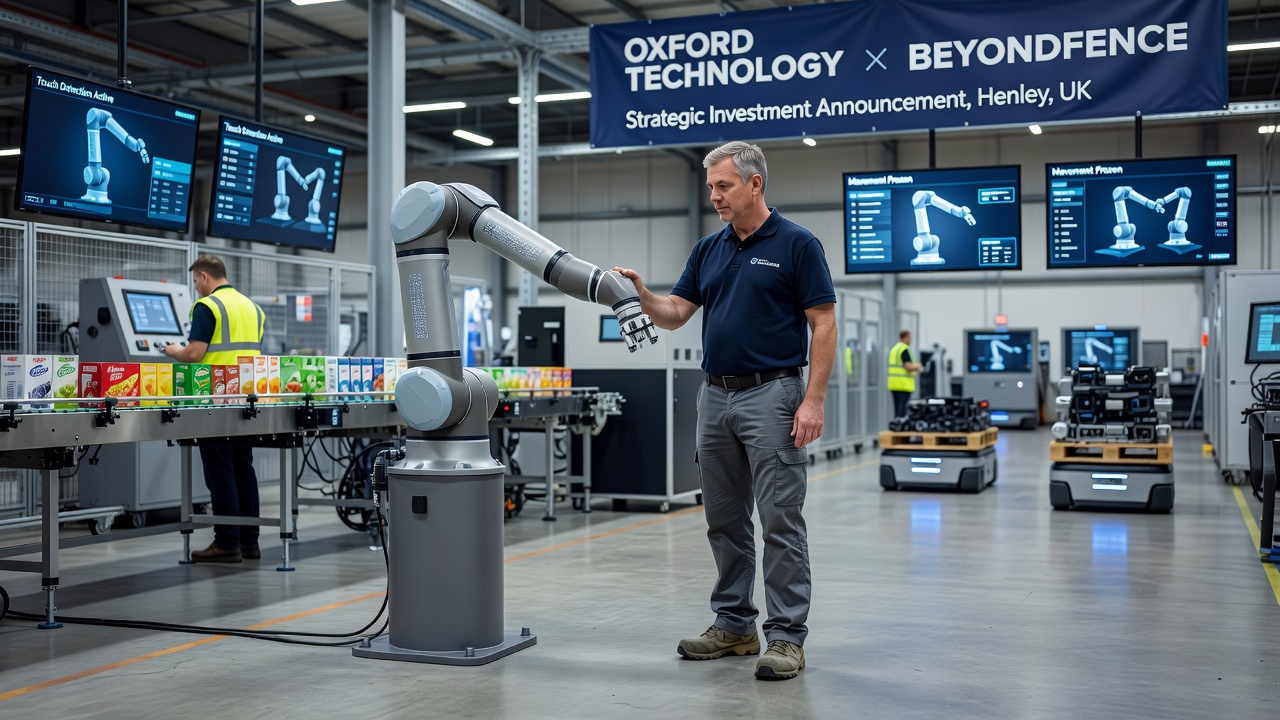
Oxford Technology has announced a strategic investment in BeyondFence, a robotics company developing ISO-compliant technology that enables humans and industrial robots to work safely together without traditional physical barriers. The funding, announced from Henley, UK, will support BeyondFence’s initial operating costs as it moves toward its first commercial sale.
Replacing Safety Cages with Intelligent Protection
In modern manufacturing environments—including food and beverage, consumer goods, life science, logistics, and automotive sectors—robots and humans are typically separated by extensive safety fencing. Current standards require barriers to extend to the maximum possible reach of a robotic arm, with systems designed to instantly shut down the robot if any object or person touches the fence. While effective for safety, these arrangements consume significant factory floor space, increase installation costs, and reduce operational flexibility.
BeyondFence solves this challenge by replacing the safety perimeter with certified intelligence built directly around the robot’s surface. The technology incorporates advanced touch-detection that allows robots to instantly freeze movement upon physical contact—such as with a human hand or torso—eliminating the need for space-consuming cages.
Industry Collaboration and Digital Twin Integration
In March 2026, Siemens Cre8Ventures announced that BeyondFence had joined the Siemens Cre8Ventures Digital Twin Marketplace. “The collaboration begins with a focus on fenceless robot automation and will expand into Autonomous Mobile Robots (AMR) and other autonomous systems,” the announcement stated. “Together, Siemens Cre8Ventures and BeyondFence will explore how digital twins can accelerate the validation, deployment, and scaling of next-generation robotics solutions across European industry.”
Founders and Market Potential
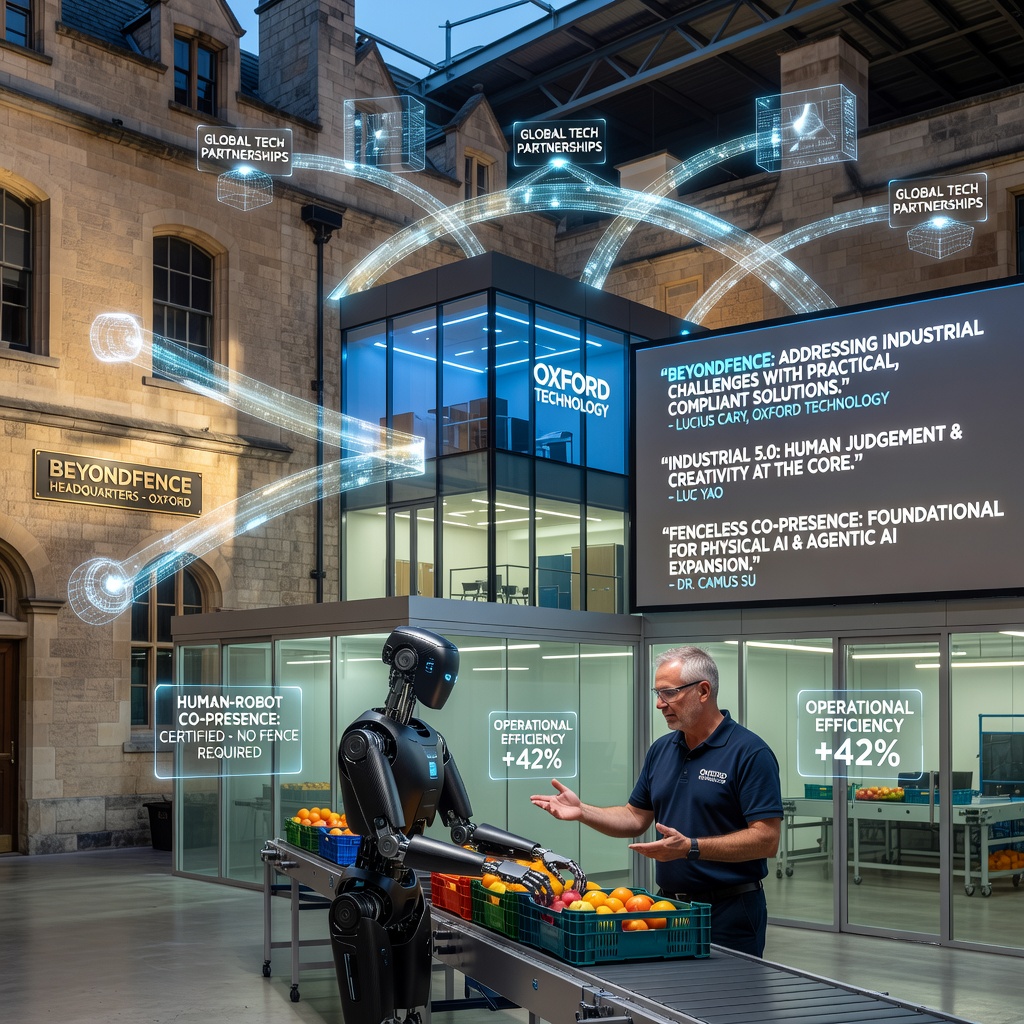
BeyondFence was founded by Luc Yao and Dr. Camus Su, both of whom bring extensive experience in robotics and industrial technology. The company is headquartered in Oxford while maintaining deep technology partnerships globally.
The investment from Oxford Technology, whose latest funds take advantage of SEIS and EIS tax reliefs, will support BeyondFence as it progresses toward securing its first commercial sale. The company is already in discussions with several prospective customers, including a potential early deployment with a major European company specialising in packing fruit for supermarket distribution—where enabling people and robots to work more closely together could deliver substantial operational and cost efficiencies.
Executive Perspectives on the Technology
Lucius Cary, founder of Oxford Technology, commented: “BeyondFence is addressing a major industrial challenge with a highly practical, compliant, technology solution. As robotics adoption accelerates at pace globally, enabling safe and efficient human-robot collaboration will be paramount. We believe the company has the potential to significantly improve factory productivity while maintaining the highest safety standards.”
Luc Yao added: “Industrial 5.0 puts human judgement and creativity back at the centre of production. BeyondFence is the infrastructure that makes that possible—safely, and at industrial scale.”
Dr. Camus Su said: “Achieving this level of certification for fenceless human co-presence is genuinely new territory in industrial safety standards. As AI evolves toward Physical AI and Agentic AI, creating a human-centric, fenceless environment is no longer just a safety preference—it is the foundational infrastructure that allows robotic AI to safely expand its application skills. We are at the beginning of what that makes possible.”
The source for this article is https://www.roboticstomorrow.com/news/2026/07/15/oxford-technology-funds-next-generation-human–robot-safety-technology-/26840/.