
Queue Raises Funding to Build Fully Autonomous Pharmacy
Queue has emerged from stealth with an autonomous pharmacy system and $12.6 million in seed funding, the company announced today. The system is designed to make prescription fulfillment faster, more accessible, and cost-effective while maintaining rigorous safety and verification protocols.
"Pharmacy in America is structurally broken," said Josh Liu, co-founder and chief technology officer of Queue. "Queue is a complete reimagining of how medications get dispensed, verified, and delivered. We built the machine the industry has needed for decades, and the demand we're seeing proves it."
Pharmacy Industry Challenges
The announcement comes as pharmacies face significant headwinds. According to Drugstore News, pharmacies are dealing with "overwhelming workloads and job dissatisfaction," with schools graduating 3,000 to 4,000 fewer pharmacists than needed over the next five to six years. The American Society of Health-System Pharmacists reports pharmacy technician vacancies at 40% or higher, a shortage that can increase the risk of human error.
Additionally, pharmacies are losing money on a growing share of prescriptions due to "negative reimbursements," compounding industry pressures. Researchers at USC and UC Berkeley found that nearly one in three pharmacies has closed since 2010, creating "pharmacy deserts." These structural forces leave the $670.6 billion U.S. retail pharmacy market with few viable paths forward.
How Queue's System Works
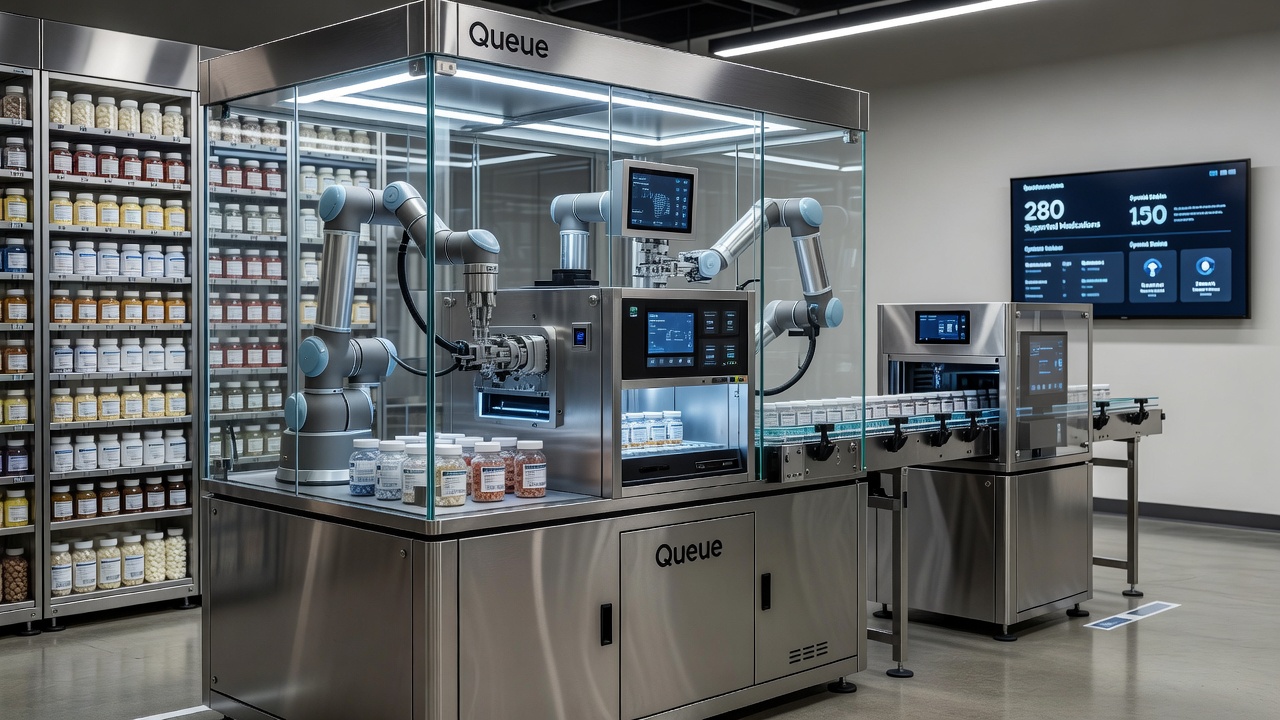
Queue was co-founded by Nick Desai, CEO, a six-time venture-backed entrepreneur who previously founded home healthcare company Heal, and Liu, whose experience spans Tesla and Zipline. The Palo Alto, Calif.-based company's robotic system fills and verifies prescriptions from sealed wholesale pill bottles without requiring an on-site pharmacist.
"We think that robotics and AI should be applied in a way that actually enables greater human flourishing," Liu told The Robot Report. "In our particular case, that would mean enabling more connection with people and enabling better service and health outcomes for the general public."
Each cell in the system can hold thousands of pills, and it can fill a vial of 60 pills every 30 seconds. Queue has developed software for security and ease of use, initially by pharmacists and eventually directly by customers. The platform currently supports 280 of the most prescribed medications in the U.S.
"The accuracy of the drugs we dispense has to be 100% end to end," Liu acknowledged. "The full chain of custody that supports safety is really critical for us."
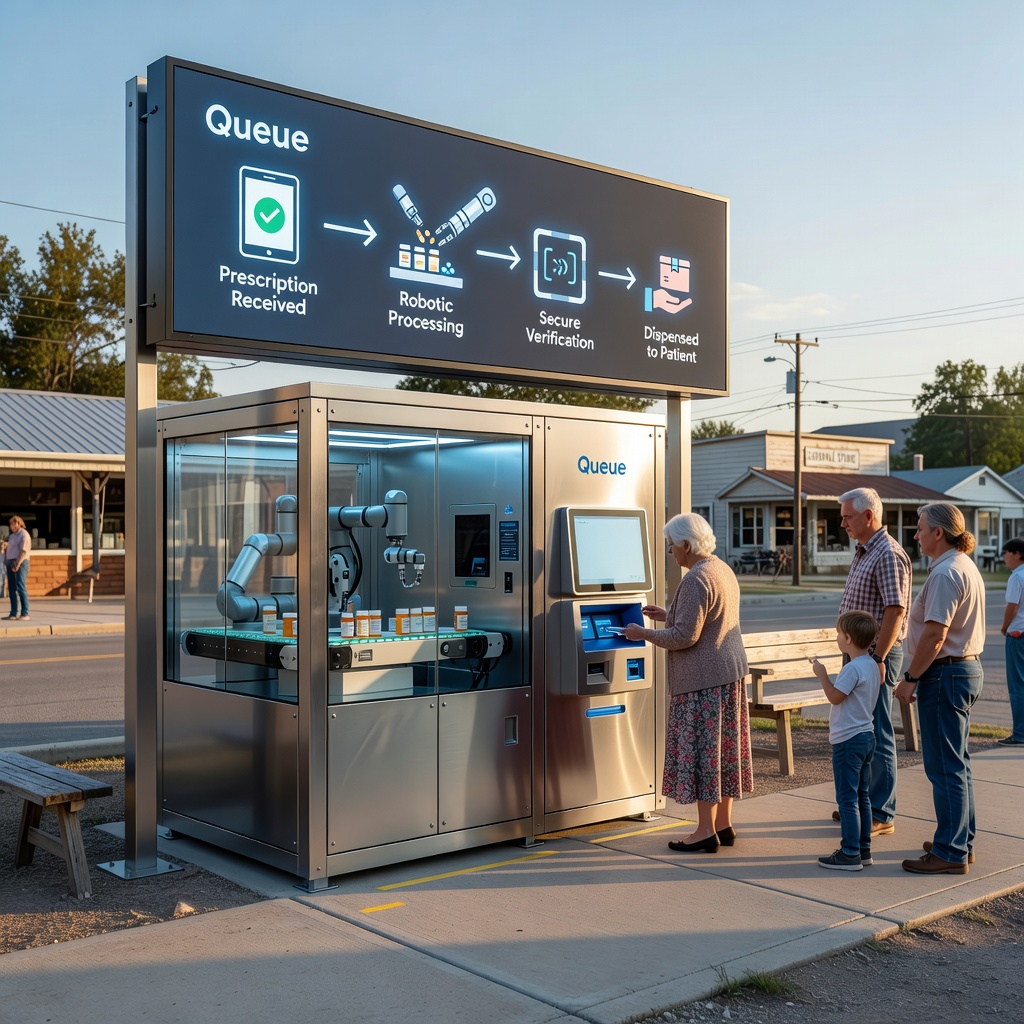
Queue said it can deliver medications at up to 96% lower cost than traditional pharmacy operations and can be deployed across rural communities and other care settings with limited pharmacy access. The company positions its system as "a new infrastructure layer for American healthcare."
Queue has already secured a major national pharmacy chain as a customer and deployed a working prototype for early commercial validation. "We're excited to get the machines out in the real world, fulfilling real prescription drugs for folks, and learning from that process. The next year is really about scaling," Liu said.
Funding and Future Plans
Queue closed an oversubscribed $12.6 million round led by AlleyCorp, following a $6 million pre-seed round led by Riot Ventures less than a year ago, bringing total funding to $18.6 million. Additional investors include House Capital, Ubiquity Ventures, Grep Ventures, and Banter Capital.
"What the Queue team has accomplished is rare in the development of hardware for healthcare," said Abe Murray, general partner at AlleyCorp. "We believe Queue is building critical infrastructure that can both increase accessibility for patients to get the prescriptions they need, while using robotics and automation to greatly improve labor constraints that exist across pharmacies."
Queue plans to use the funding to accelerate product development, expand deployments with enterprise pharmacy customers, and grow its engineering team. The company currently has 20 engineers in Silicon Valley with experience from Rivian, Waymo, and aerospace companies, and is actively hiring across robotics, hardware, software, and pharmacy operations.
"People think of pharmacies as not necessarily the flashiest, sexiest thing, but I think what draws both our talent as well as the folks who have invested in us is they see it more as a systemic issue," Liu said. "It's one that, quite frankly, our nation hasn't resolved, and it's only getting worse. So we're really hitting on something pretty foundational that's going to be impactful for many, many years."
The source for this article is https://www.therobotreport.com/queue-raises-funding-fully-autonomous-pharmacy/.