
Tickets, geofences, and 1M miles: The new reality of California AV compliance - The Robot Report
California is fundamentally reshaping its approach to autonomous vehicle (AV) oversight, moving away from the tech industry's familiar "move fast and break things" ethos toward strict accountability, real-time enforcement, and rigorous mileage requirements. The shift marks a significant milestone for AV development nationwide, with implications for everything from robotaxis to autonomous heavy trucks.
Harold Braun, executive chairman and CEO of Guident, a company specializing in remote monitoring and control systems, described the changes as a "game changer" in an interview with The Robot Report. "What happened in California at the moment is very important, because it opens the pathway to not only testing in a geo-fenced area, but also allowing it to happen right on a public road," Braun said. "And that, of course, has implications for the developers." He emphasized that the new rules clearly outline safety, oversight, emergency response, remote operation, and accountability requirements.
Three Classes of Federal Oversight
While states craft their own rules, federal oversight of AVs is split among three distinct vehicle classes. Purpose-built AVs—vehicles designed from the ground up without steering wheels or pedals—fall under the National Highway Traffic Safety Administration (NHTSA). Consumer passenger vehicles, from standard Subarus to luxury Jaguars equipped with drive-by-wire systems, must comply with Federal Motor Vehicle Safety Standards (FMVSS), also managed by NHTSA. Commercial vehicles, including light and heavy trucks often retrofitted with autonomous technology, are regulated by the Federal Motor Carrier Safety Administration (FMCSA).
California’s new regulations provide a framework for deploying AVs—including heavy trucks—outside geofenced areas and onto public roads, interacting directly with other traffic and pedestrians.
Key Requirements Under California's New Rules
Braun detailed 10 major provisions that now govern AV operations in the state. These include:
-
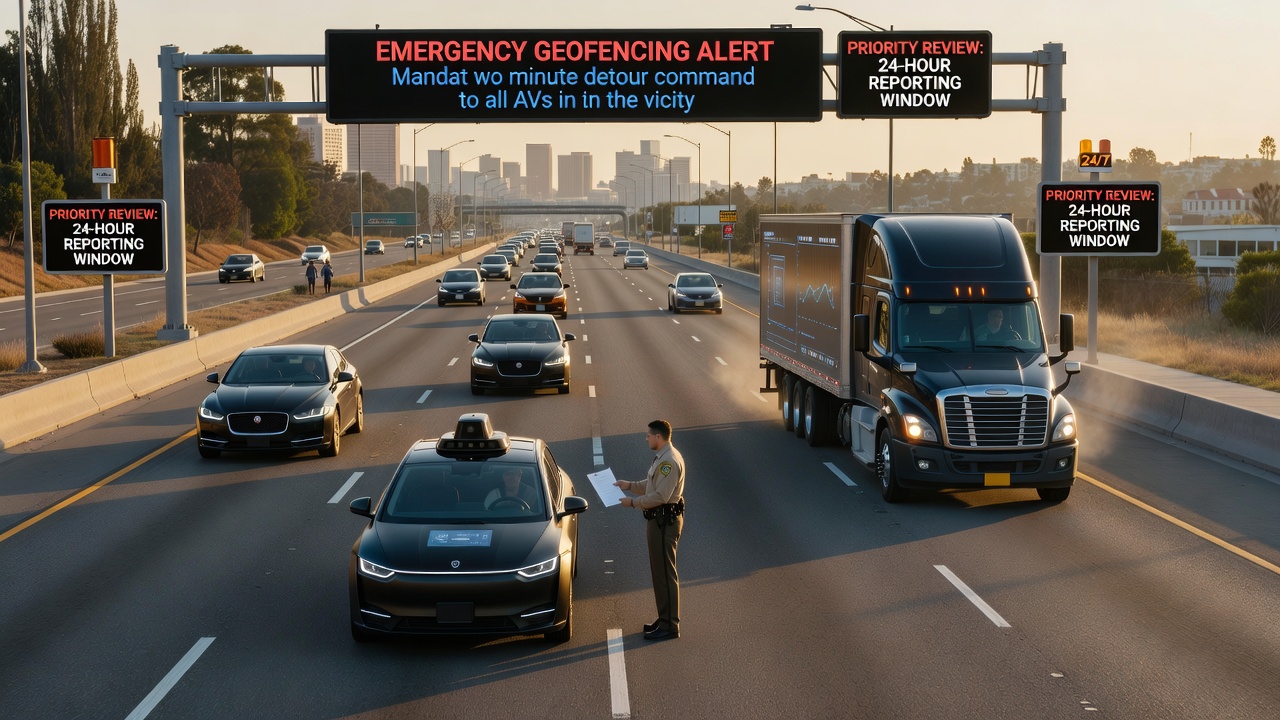
Notices of noncompliance: Police officers can now issue formal citations to driverless vehicles for traffic violations. Instead of a ticket given to a person, the officer sends a "notice of AV noncompliance" to both the vehicle manufacturer and the California Department of Motor Vehicles (DMV).
-
72-hour/24-hour reporting window: Manufacturers must submit all relevant vehicle data, telemetry, and an explanation to the DMV within 72 hours of receiving a noncompliance notice. If the violation is marked as a "priority review" due to public danger, the window shrinks to 24 hours.
-
Two-minute emergency geofencing: Local emergency officials can transmit a digital "emergency geofencing message" during crises such as fires or active crime scenes. AV manufacturers must then command their entire fleet to detour or exit the geofenced zone within two minutes.
-
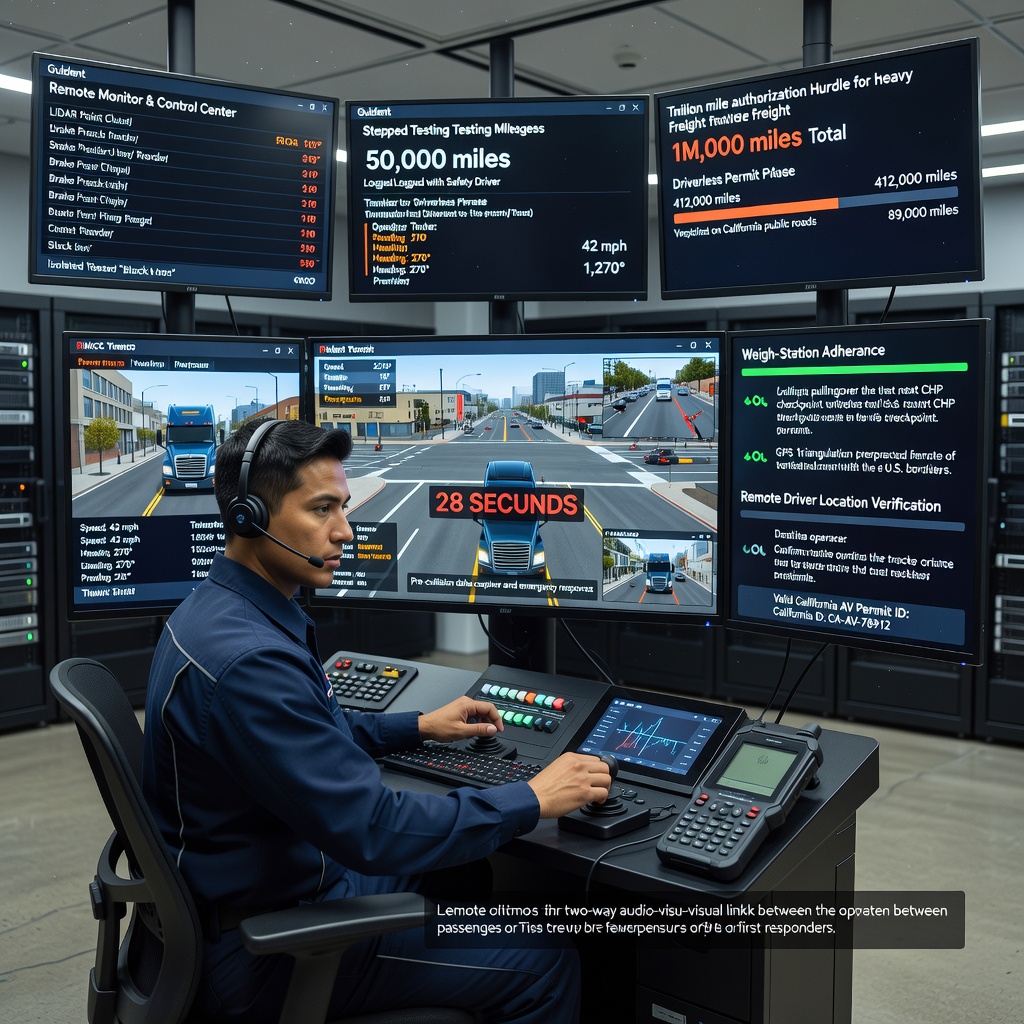
30-second first responder response time: Every driverless vehicle must have a built-in two-way voice communication system. When a first responder uses it or calls the mandatory 24/7 priority line, a remote human operator with full situational awareness must answer within 30 seconds.
-
30-second pre-collision data capture: Vehicles must include a dedicated, isolated data-recording mechanism (like a flight's "black box") that continuously captures and stores at least 30 seconds of read-only sensor data preceding any collision. The data cannot be overwritten or wiped before state investigators download it.
-
Stepped testing mileage for light-duty vehicles: To earn a commercial deployment permit for robotaxis, companies must log 50,000 autonomous miles with a safety driver to obtain a driverless testing permit, then another 50,000 miles under that permit before transitioning to commercial, fare-charging deployment.
-
1 million-mile hurdle for heavy freight: Heavy-duty autonomous trucks (over 10,001 lb.) must log a total of 1 million autonomous miles across authorization tiers, including at least 200,000 miles specifically on California public roads, before they can deploy commercially.
-
Commercial weigh-station compliance: Autonomous semi-trucks are required to pull over and pass through all California Highway Patrol weigh stations, adhering to the same commercial safety and weight audits as human-driven trucks.
-
Domestic location and permit rules for remote drivers: Remote drivers who can actively execute dynamic driving tasks must be physically located within the U.S. and hold a valid California driver’s license. They must also obtain individual state-issued AV operating permits.
-
Direct permit revocation for system failures: The DMV’s authority is expanded to trigger immediate permit suspensions, operational boundary rollbacks, or total revocations if a fleet demonstrates repeated hardware/software failures, blocks emergency responses, or fails to address underlying technology issues.
How Advanced Remote Monitoring Enables Compliance
Braun noted that Guident built its Remote Monitor & Control Center (RMCC) specifically to address these new accountability demands. The RMCC includes capabilities for remote monitoring, assistance, control, teleoperation, and analytics. It enables remote operators to monitor and interact with vehicles in a performant way, interact with first responders, and quickly triage emergencies. A personal communication module facilitates two-way communication between remote operators and vehicle passengers, helping manufacturers meet the 30-second response requirement and other emergency protocols.
"This comes with certain accountabilities and also with certain regulations, and these are very clearly described in that law," Braun said. "There are safety requirements, oversight requirements, emergency response requirements, remote operation requirements, and accountability requirements, and I built Guident around these capabilities."
The source for this article is https://www.therobotreport.com/tickets-geofences-1m-miles-new-reality-california-av-compliance/.