
Tiny Robot Boats Assemble Themselves Into Floating Structures
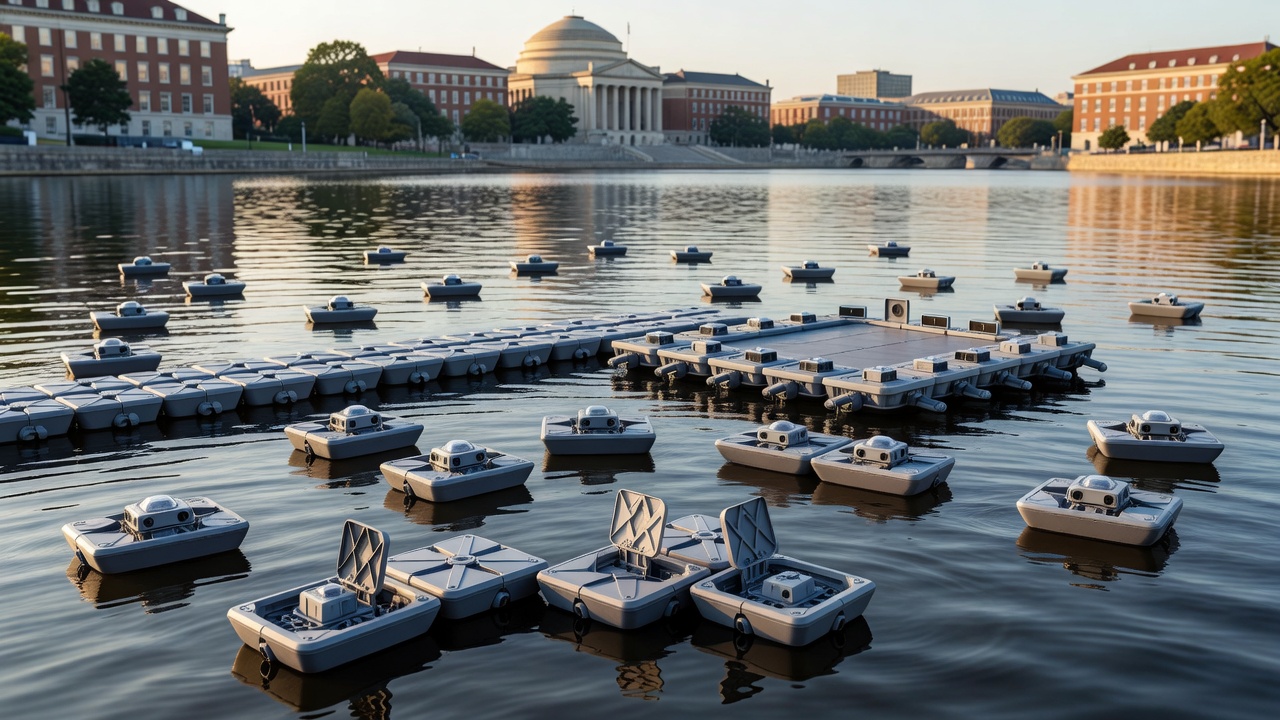
A team of MIT researchers has developed a system of small robotic boats that autonomously link together to form larger floating structures, then break apart and reassemble into new configurations. Called FloatForm, the platform turns waterways into programmable, adaptive spaces. Each robot measures just 21 centimeters square—about the size of a dinner plate—and is equipped with thrusters, sensors, and magnetic latches. Together, they can create temporary bridges, emergency platforms, floating markets, or festival stages that dissolve when no longer needed.
“Our FloatForm project envisions a future where the waterfront becomes a programmable extension of the city,” says Daniela Rus, director of MIT’s Computer Science and Artificial Intelligence Laboratory (CSAIL). “This kind of distributed robotics opens new possibilities for mobility, emergency response, public space, and infrastructure on water.”
Lessons from Fire Ants
The team turned to biology for inspiration. Fire ants survive floods by linking their bodies into rafts without a central leader—each ant follows simple local rules to create a resilient structure. FloatForm operates on a similar principle. Rather than relying on a single central computer to dictate every move—a method vulnerable to failure and poor scaling—the system uses a lightweight central planner that only intervenes to assign final positions. All other tasks, including navigation, collision avoidance, and adapting to disturbances, are handled by the robots themselves, which exchange positions with nearby neighbors. This allows the entire swarm to move simultaneously.
“The beauty of this largely decentralized approach is that the computation doesn’t get bogged down as the swarm grows,” says Wei Wang, lead author of the study and now at the University of Wisconsin at Madison. “Whether you are working with eight boats or 80, the entire fleet coordinates and moves simultaneously.”
An Origami-Inspired Latching System
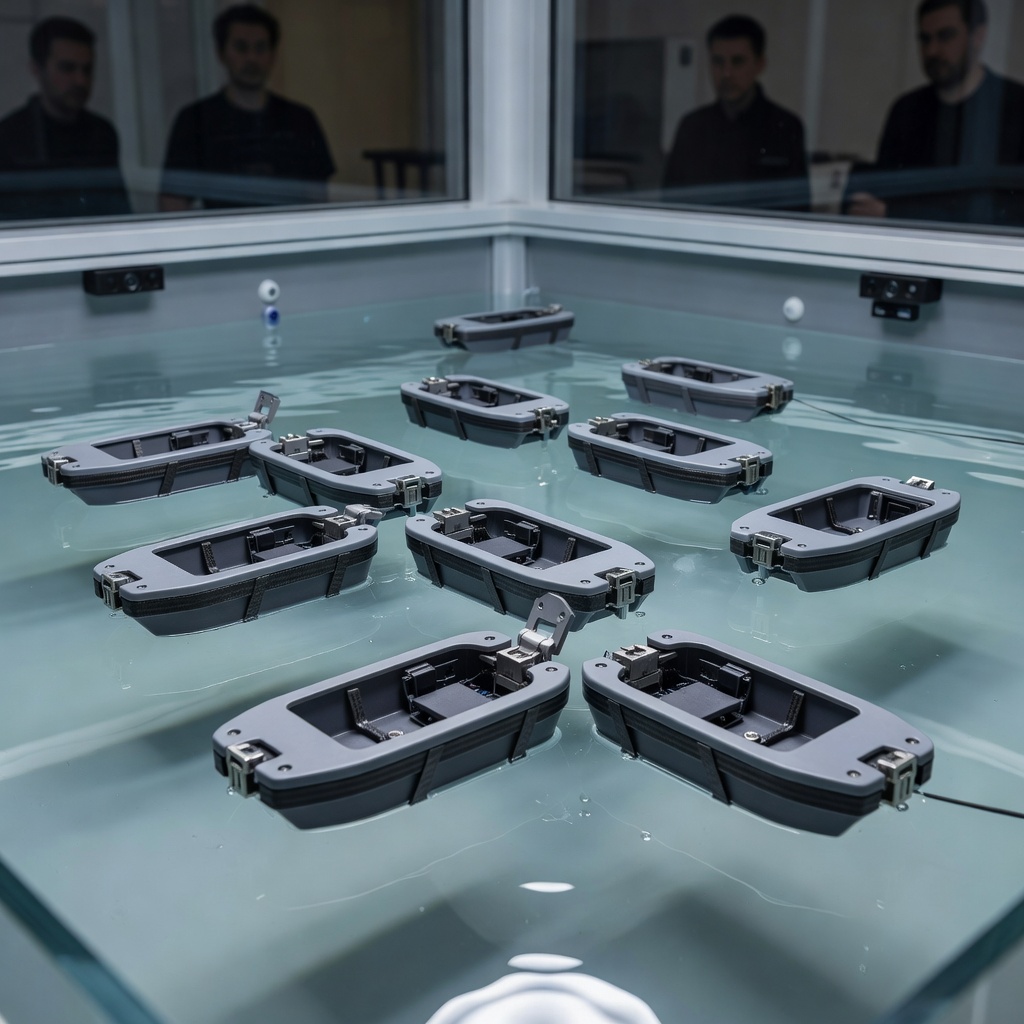
The robots connect using a latching mechanism hidden inside each hull. A single servo motor drives an origami-like auxetic structure that contracts or expands uniformly in all directions, pulling or pushing permanent magnets on all four sides. The magnets are arranged with alternating polarities, ensuring the boats click together into clean square lattices. Crucially, a 3D-printed gearbox holds the latch in either state with the motor switched off, consuming no power between latching and delatching. This energy efficiency is vital for small robots with limited batteries.
“Because the robots are so small, you can only have a battery so big,” explains Alejandro Gonzalez-Garcia, a former CSAIL researcher. “If they use less energy on latching, they can use more on computation, or on actually moving.”
Proven in the Lab, Eyeing the Real World
In experiments at MIT, a fleet of eight robots repeatedly assembled from random positions into target shapes, latched into rigid structures, broke apart on command, and reassembled into new configurations—all without human intervention 70 to 90 percent of the time. Each run took four to eight minutes. Simulations showed the framework scaling smoothly to swarms of 64 robots.
Moving from a controlled indoor tank to real canals or harbors will require stronger latches, weatherproofing, and GPS or vision-based sensing. But the coordination algorithm was designed to be sensor-agnostic, making the transition feasible.
“We explored whether canals could be used for waste collection or transport,” says Niklas Hagemann, an MIT graduate student and CSAIL affiliate. “Urban areas are getting denser, so could you expand public space onto water that’s currently underutilized?”
A Future of Adaptive Water Infrastructure
Applications extend beyond city canals. The team envisions temporary platforms for offshore inspections, adaptive sensor networks for studying wildlife, and reconfigurable docking stations for emergency response in remote areas. “Venice, the Netherlands, Belgium, the fjords and lakes of Norway—really any city with a river can take advantage of this,” says Gonzalez-Garcia. “The project uses spaces where water is already important, but it also raises the question: Where else can water be used for something more?”
The research, published today in Nature Communications, comes from the labs of Daniela Rus and Carlo Ratti, professor of urban technologies at MIT. It builds on Roboat, their earlier project that placed full-size autonomous vessels on Amsterdam’s canals. Support came from the Amsterdam Institute for Advanced Metropolitan Solutions and the University of Wisconsin at Madison.
The source for this article is https://news.mit.edu/2026/tiny-robot-boats-build-floating-structures-0709.