
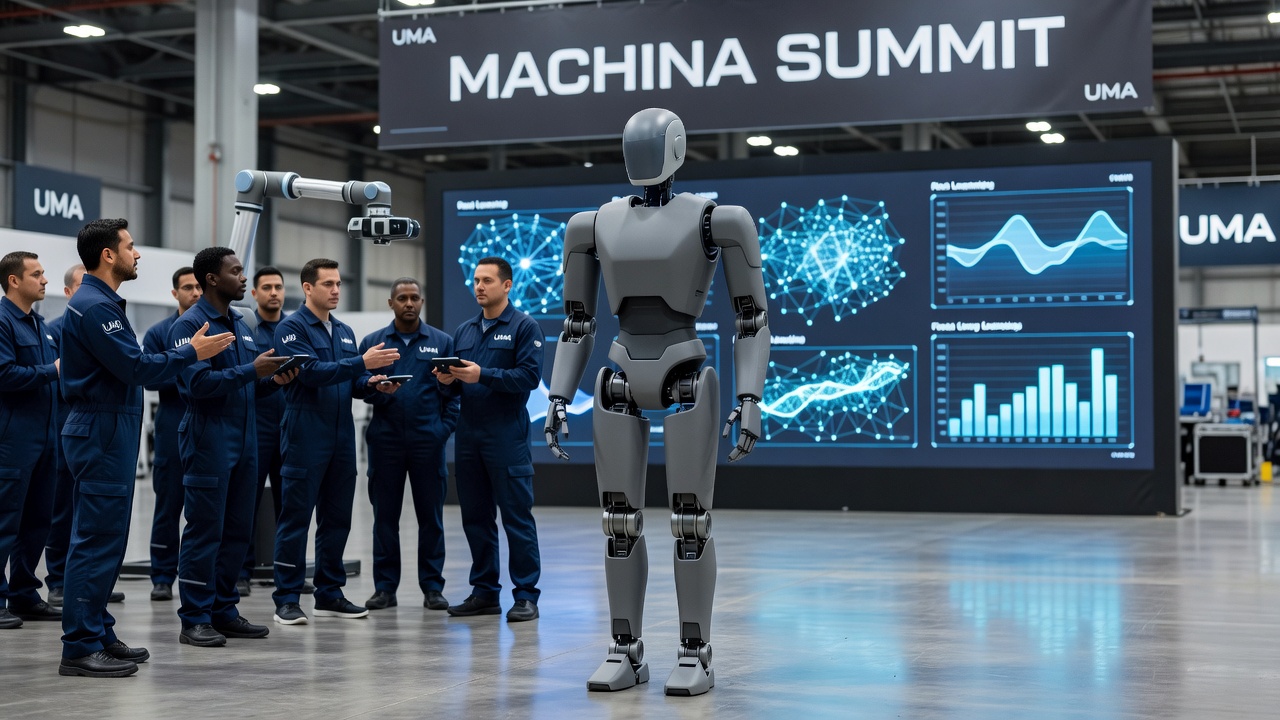
UMA Unveils Its Vision for the Next Generation of Humanoid Robots
At the Machina Summit, Physical AI company UMA unveiled the design of its first humanoid robot and introduced Real-Time Learning, a novel AI architecture that allows robots to acquire new skills through demonstration rather than traditional manual programming. The announcement positions UMA as a new entrant in the competitive humanoid robotics space.
Addressing Global Labor Shortages
The launch comes amid mounting pressures on labor markets worldwide, driven by aging populations, industrial reshoring, and the energy transition. According to Korn Ferry, the global economy may face a shortage of 85 million workers by 2030, potentially resulting in $8.5 trillion in lost economic output. UMA aims to address this gap with intelligent robots designed to take on physically demanding, repetitive, or hazardous tasks.
“Demographic, industrial, and environmental challenges all point to the same reality: societies need greater productive capacity,” said Rémi Cadène, CEO and co-founder of UMA. “We believe intelligent robots will become part of the solution, not as a substitute for people, but as a new class of tools that enables them to devote more time to what machines will never replace: creativity, judgment, innovation, and caring for others.”
Robotics Designed for Real-World Industrial Environments
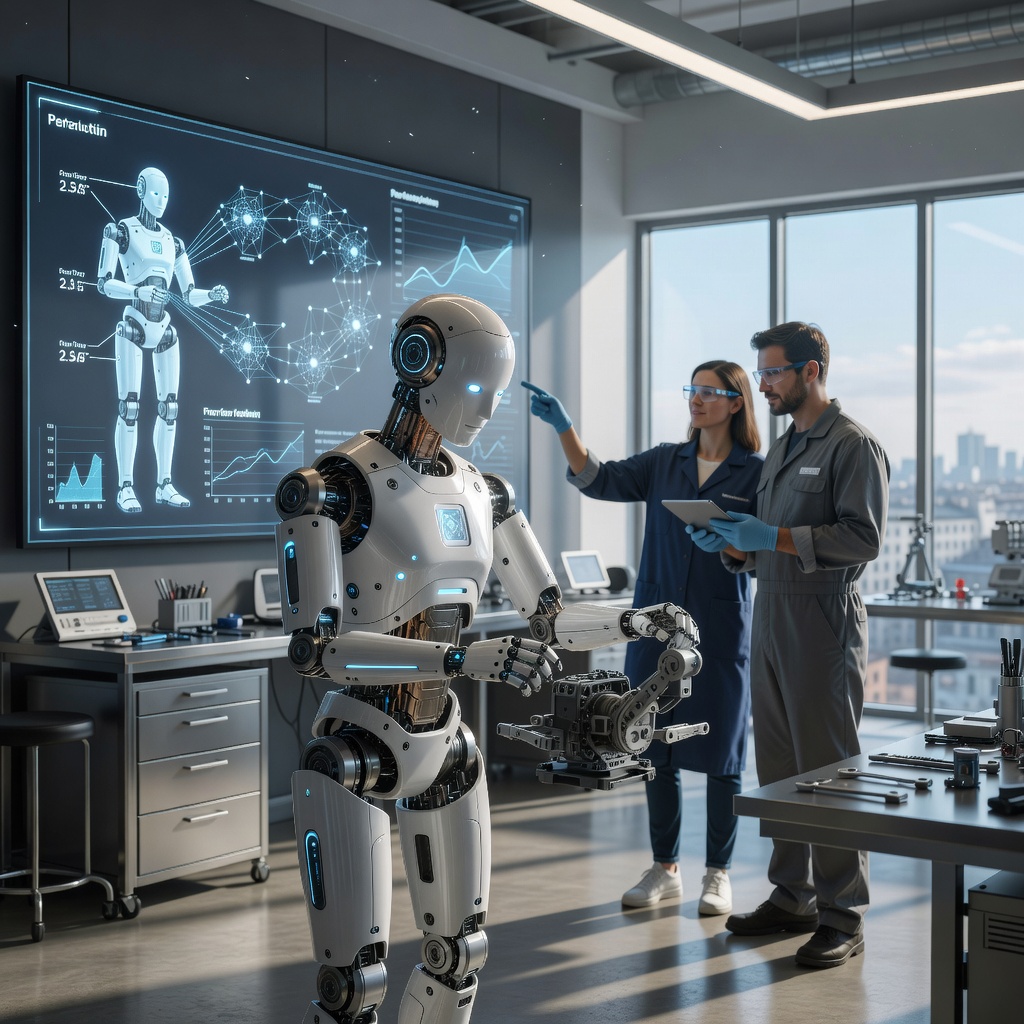
UMA’s humanoid robot is engineered for immediate deployment in factories, warehouses, logistics centers, and industrial facilities—spaces already built for people. The humanoid form factor allows the robot to use existing tools, integrate into current infrastructure, and collaborate alongside human teams without requiring extensive facility modifications.
In a departure from much of the current humanoid robotics landscape, which Cadène describes as swinging between overly mechanical machines and consumer-inspired friendly designs, UMA has opted for what it calls a “dressed machine.” The robot features human-scale proportions with a neutral visor instead of facial features, paired with a soft technical outer shell and intentionally visible mechanical joints. This design aims to eliminate ambiguity between person and machine while embracing the robot’s identity rather than concealing it. The goal is to earn trust through consistent, everyday use rather than through short-lived stage demonstrations.
Real-Time Learning: Teaching Robots Like Humans
Central to UMA’s platform is Real-Time Learning, an architecture that enables robots to learn tasks through observation, experimentation, and practice—mirroring how humans acquire new skills. Instead of requiring engineers to reprogram robots for each new task, the platform allows robots to adapt to unfamiliar situations and continuously refine performance through experience. This approach promises greater flexibility and easier deployment across diverse industrial settings.
“The industry’s challenge is no longer building robots capable of executing individual tasks,” Cadène explained. “The next breakthrough lies in building robots capable of learning new ones.”
Europe’s Opportunity in Physical AI
While the humanoid robotics race is currently dominated by the United States and China, UMA believes Europe offers a unique environment to lead the next phase of Physical AI development. The region combines world-class scientific research, a strong industrial base, and growing automation demand due to structural labor shortages. UMA, headquartered in Paris with teams in London and Geneva, sees Europe not just as its birthplace but as the fastest path to creating value with intelligent robots.
A Vision for Expanding Human Potential
The unveiling reflects UMA’s broader mission for Physical AI: machines that continuously learn, adapt, and work alongside people to tackle pressing societal challenges. Cadène likens the journey to the internet and smartphones, which took years to transform industries. “One day, robots will contribute to manufacturing future generations of robots, accelerating their own deployment,” he said. “But our ambition has never been to replace people. It is to expand what people are capable of.”
Founded in 2025 by Rémi Cadène, Pierre Sermanet, Robert Knight, and Simon Alibert, UMA combines expertise in frontier AI, robotics, embodied intelligence, embedded systems, and industrial engineering. The company is building a Physical AI platform designed to help industries address labor shortages while enabling people to focus on higher-value work.
The source for this article is https://www.roboticstomorrow.com/news/2026/07/07/uma-unveils-its-vision-for-the-next-generation-of-humanoid-robots/26813/.