
When Plasma Becomes Visible: Multi-Camera Imaging Unlocks New Insights into Hyper-Dynamic Plasma Jets
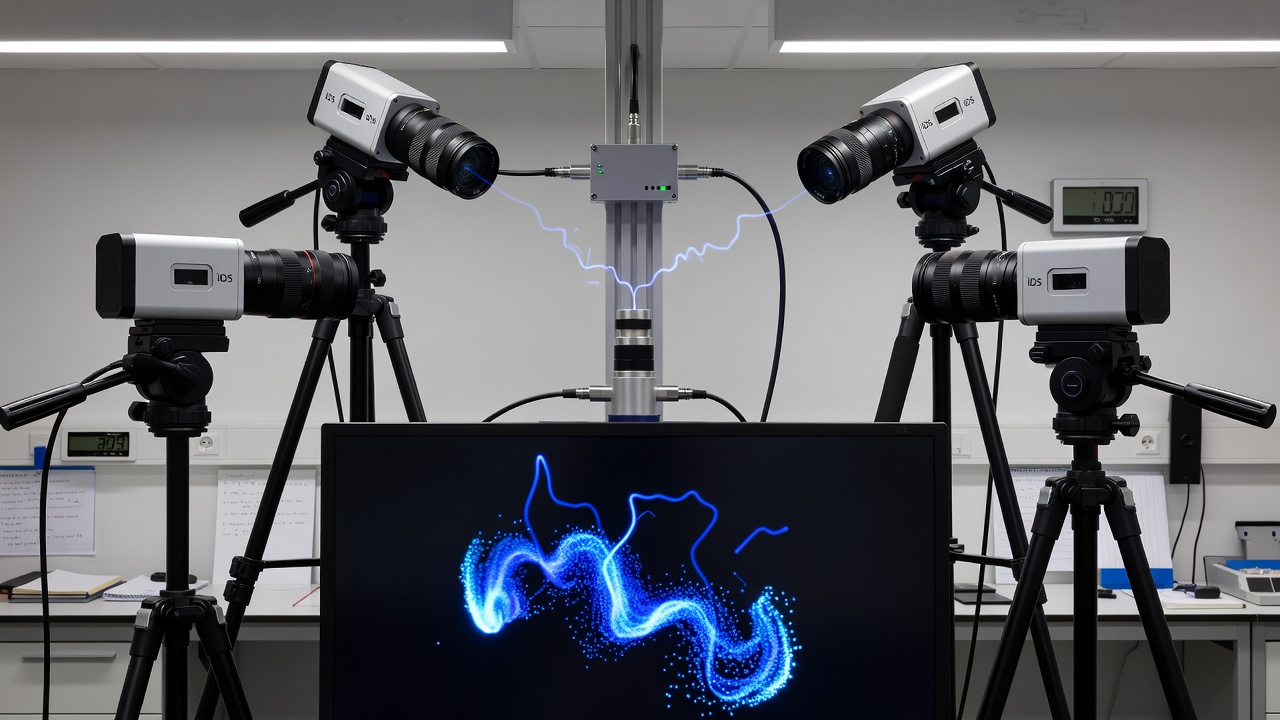
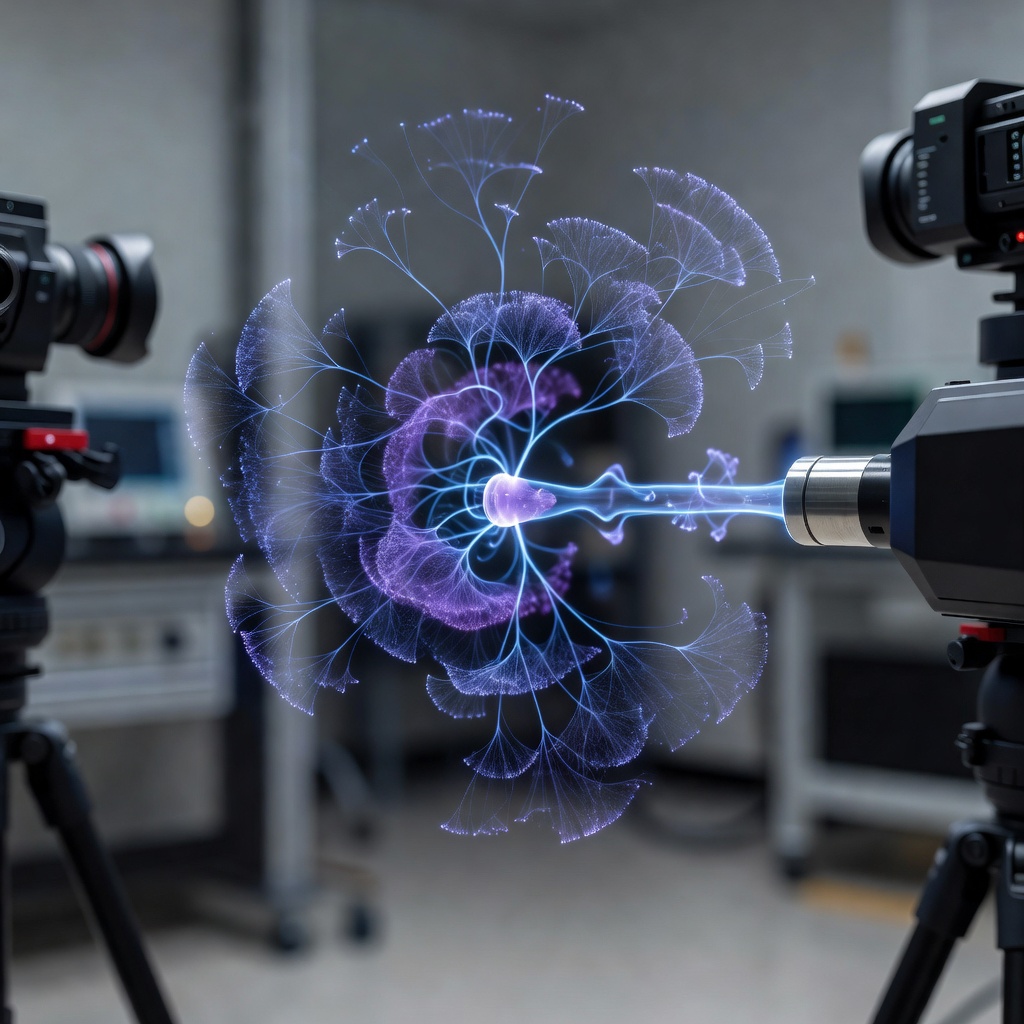
At the Leibniz Institute for Plasma Science and Technology (INP) in Greifswald, Germany, researchers are pushing the boundaries of experimental physics to make the invisible visible. The “Medical Plasma Source Systems” (MPS) research group, led by Dr. Torsten Gerling, has developed a multi-camera imaging system that captures the three-dimensional structure of highly dynamic plasma jets—phenomena that change in mere microseconds and span only millimeters. Their work focuses on the kINPen, an ambient-pressure cold plasma source built entirely at the INP, which produces a self-luminous plasma filament that is both erratic and minuscule (0.1 mm in diameter, 10 mm in length). By synchronizing five industrial cameras from IDS, the team can reconstruct the discharge's spatial behavior as a 3D point cloud, providing a foundation for better understanding and controlling plasma jets in medical and technological applications.
The Challenge of Imaging Plasma
Plasma discharges are among the most difficult experimental subjects to study. They are small-scale, highly dynamic, and change within microseconds. The kINPen plasma jet, in particular, has a discharge period of just 1 µs and a spatial extent of roughly 10 mm. To capture individual discharge channels, the researchers use exposure times ranging from 9.35 to 30.03 microseconds—barely enough to freeze the action. “The key point here is that all cameras must operate in perfect synchronization, as this is the only way to capture the same features within a very short time frame,” explains Artur Wittig, a research associate at the INP. Without multiple simultaneous views, the three-dimensional distribution of the plasma filaments remains speculative. The team’s multi-view stereo approach solves this by imaging the discharge from five angles, enabling reliable reconstruction of curvature, coiling, or lateral deflection.
Multi-Camera Setup and Synchronization
The imaging system uses five IDS uEye CP U3-31J0CP Rev. 2.2 industrial cameras, chosen for their precise hardware triggering and synchronization capabilities. Each camera is equipped with a global shutter Sony Pregius S CMOS sensor (IMX546) with 8.13 megapixels and backside illumination (BSI), which allows short exposure times even under low-light conditions—essential because the plasma filament’s brightness is comparable to that of a firefly at a 500 mm viewing distance. High-aperture 75 mm lenses (f/2.8) with a large 1.2-inch image circle ensure distortion-free imaging of the fine discharge structures. “Only the combination of sensor and optics makes it possible to achieve high-quality images despite microsecond exposure times,” notes Dr. Philipp Mattern, who provided scientific and technical support through his firm M.E.S.S. Integration is handled via the IDS peak SDK and Python API, enabling parallel operation, triggering, and image storage. The careful calibration of the multi-camera setup allows the identification of distinctive structures in the plasma as cross-image point correspondences, from which the 3D structure is reconstructed.
Results and Future Applications
The methodology has yielded an experimental proof of concept: for the first time, the highly dynamic plasma discharge of a kINPen jet has been reconstructed as a 3D point cloud and systematically analyzed. “This allows us not only to visualize the plasma structure, but also to analyze it systematically,” says Wittig. The current work continues to explore altered operating parameters such as gas flow and discharge mode. Researchers also envision applying the technique to other dynamic structures and complementing it with imaging methods like Schlieren or Background Oriented Schlieren (BOS) techniques, which visualize invisible flows and density differences near the plasma. “In applications involving highly dynamic objects such as plasma discharges, it is not individual features that are decisive, but rather the combination of a global shutter sensor and precise, reproducible exposure control via hardware triggering to synchronize multiple cameras,” sums up Heiko Seitz, Product Marketing Manager at IDS. The multi-camera system opens new doors in experimental plasma research—making the fleeting visible and the invisible measurable.
The source for this article is https://www.roboticstomorrow.com/news/2026/07/07/when-plasma-becomes-visible-multi-camera-image-processing-for-new-insights-into-highly-dynamic-plasma-jets/26818/.