
Why physical AI 2.0 needs a reality check - The Robot Report
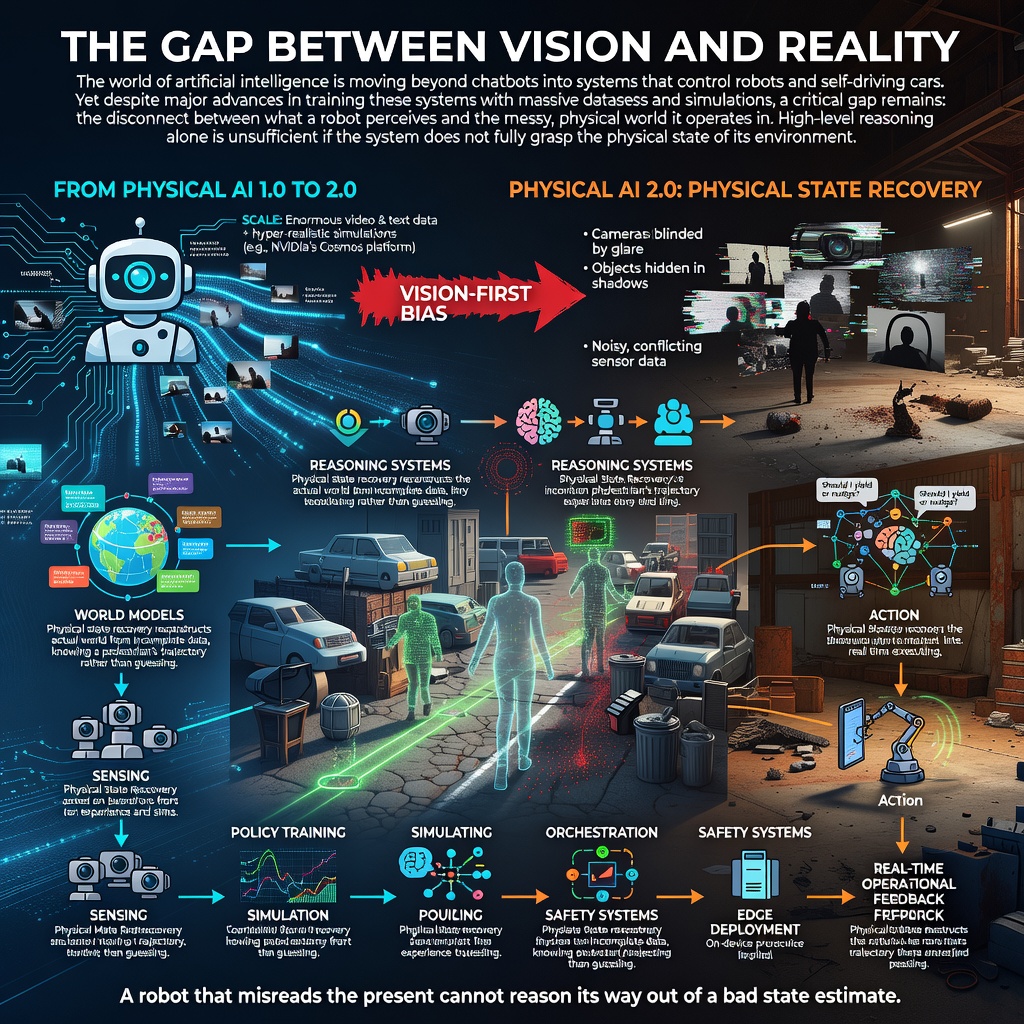
The world of artificial intelligence is moving beyond chatbots into systems that control robots and self-driving cars. Yet despite major advances in training these systems with massive datasets and simulations, a critical gap remains: the disconnect between what a robot perceives and the messy, physical world it operates in. High-level reasoning alone is insufficient if the system does not fully grasp the physical state of its environment.
From physical AI 1.0 to 2.0
The current industry standard, dubbed “physical AI 1.0,” centers on scale—feeding enormous amounts of video and text data, along with hyper-realistic simulations such as NVIDIA’s Cosmos platform, to teach machines about the world before they ever move. However, this approach suffers from a “vision-first” bias: it assumes enough cameras and compute power will let a robot accurately predict the future. In practice, cameras can be blinded by glare, objects can hide in shadows, and sensors can produce noisy, conflicting data.
“Physical AI 2.0” introduces a new essential layer: physical state recovery. The unit of competition in physical AI is no longer just the model. In digital AI, the model is often the product; in embodied systems, the model must work with sensing, simulation, policy training, orchestration, safety systems, edge deployment, and real-time operational feedback. A robot that misreads the present cannot reason its way out of a bad state estimate.
The new architecture of action
To function safely in the real world, a physical AI system needs four distinct capabilities operating in a loop:
- World models: These provide learned “priors”—knowledge of what might happen based on past experience and simulations.
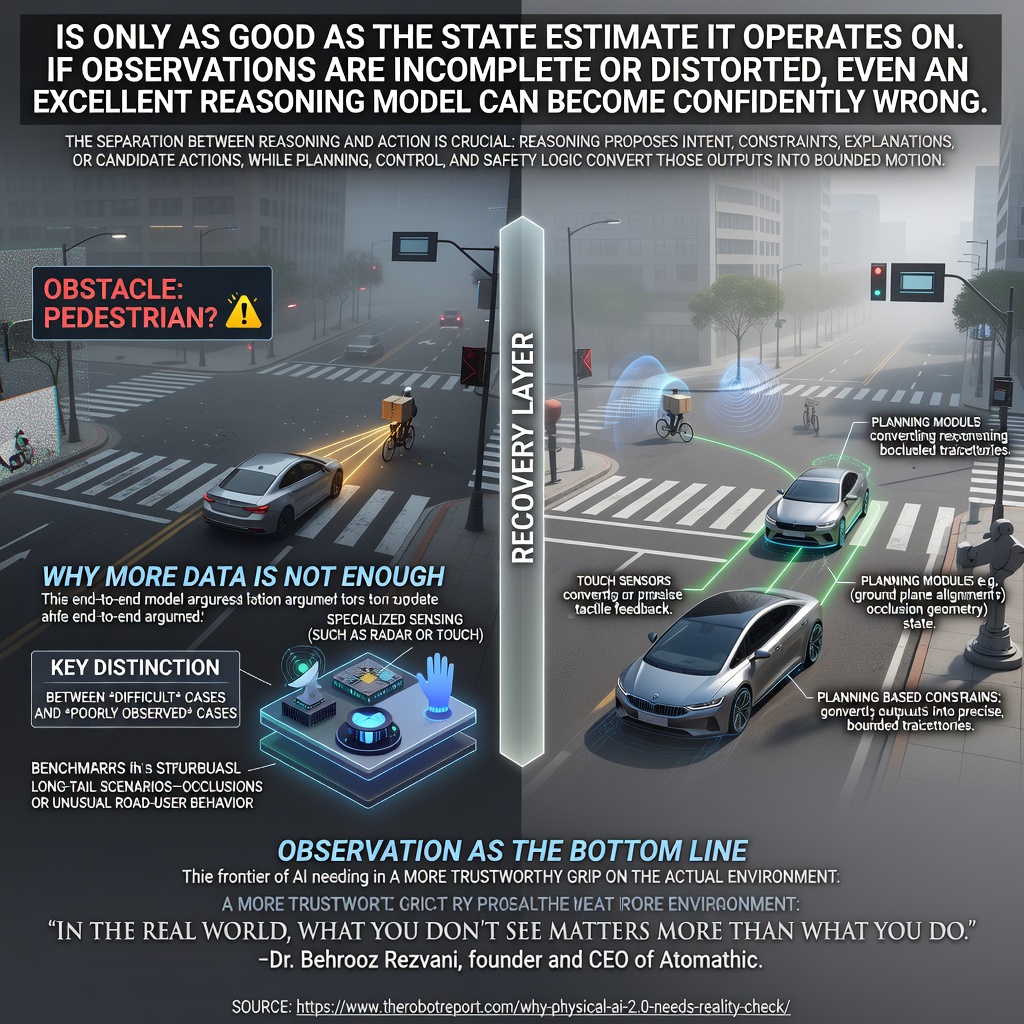
- Physical state recovery: Described as the “missing link,” this module takes noisy, incomplete sensor data and reconstructs the actual physical state of the world. It is the difference between guessing where a pedestrian is and knowing their exact trajectory through a cluttered scene.
- Reasoning systems: Once the state is recovered, the AI deliberates, compares options, weighs risks, and decides on the best intent—for example, “Should I yield or nudge?”
- Action: The final step executes movement within strict safety boundaries.
Reasoning is only as good as the state estimate it operates on. If observations are incomplete or distorted, even an excellent reasoning model can become confidently wrong. The separation between reasoning and action is crucial: reasoning proposes intent, constraints, explanations, or candidate actions, while planning, control, and safety logic convert those outputs into bounded motion.
Why more data is not enough
A common counterargument holds that bigger “end-to-end” models will eventually learn to handle noisy sensors on their own. But a dedicated recovery layer is more efficient. By treating physical state recovery as its own module, developers can exploit specialized sensing (such as radar or touch) and improve observability before higher-level reasoning begins. This avoids having every new robot “relearn” basic physics from scratch.
The key distinction is between difficult cases and poorly observed cases. Benchmarks can identify that a system struggles with long-tail scenarios—occlusions or unusual road-user behavior. But recognizing a hard case is not the same as recovering what the sensors failed to capture. A camera can produce more frames, and a model can analyze them longer, but if the underlying observation is structurally degraded, downstream reasoning may still operate on the wrong picture. The answer is not simply more data; it is a stronger recovery layer that uses physics-based constraints and richer sensing to make the hidden state more visible.
Observation as the bottom line
The next frontier of AI is not just about making models “smarter” at reasoning—it is about making them “better” at observing. The winner of the AI race will be the system that most accurately bridges the gap between digital prediction and physical reality. Vision and language are a start, but for physical AI to truly graduate into the real world, it needs a more trustworthy grip on the actual environment it is trying to navigate. As Dr. Behrooz Rezvani, founder and CEO of Atomathic, puts it: “In the real world, what you don’t see matters more than what you do.”
The source for this article is https://www.therobotreport.com/why-physical-ai-2-0-needs-reality-check/.