
Why robotics teams need virtual gyms before deployment - The Robot Report
The next frontier for robotics isn't just automating a fixed task—it's learning to handle unpredictable environments. As the industry pivots toward "physical AI," where systems perceive, reason, and act in the real world, the need for extensive training before deployment has become critical. With the global robotics market expected to grow at a 19.6% compound annual growth rate from 2026 to 2036, according to Future Market Insights, teams are turning to high-fidelity simulation environments known as "virtual gyms" to bridge the gap between controlled testing and live operations.
The sim-to-real gap is a production bottleneck
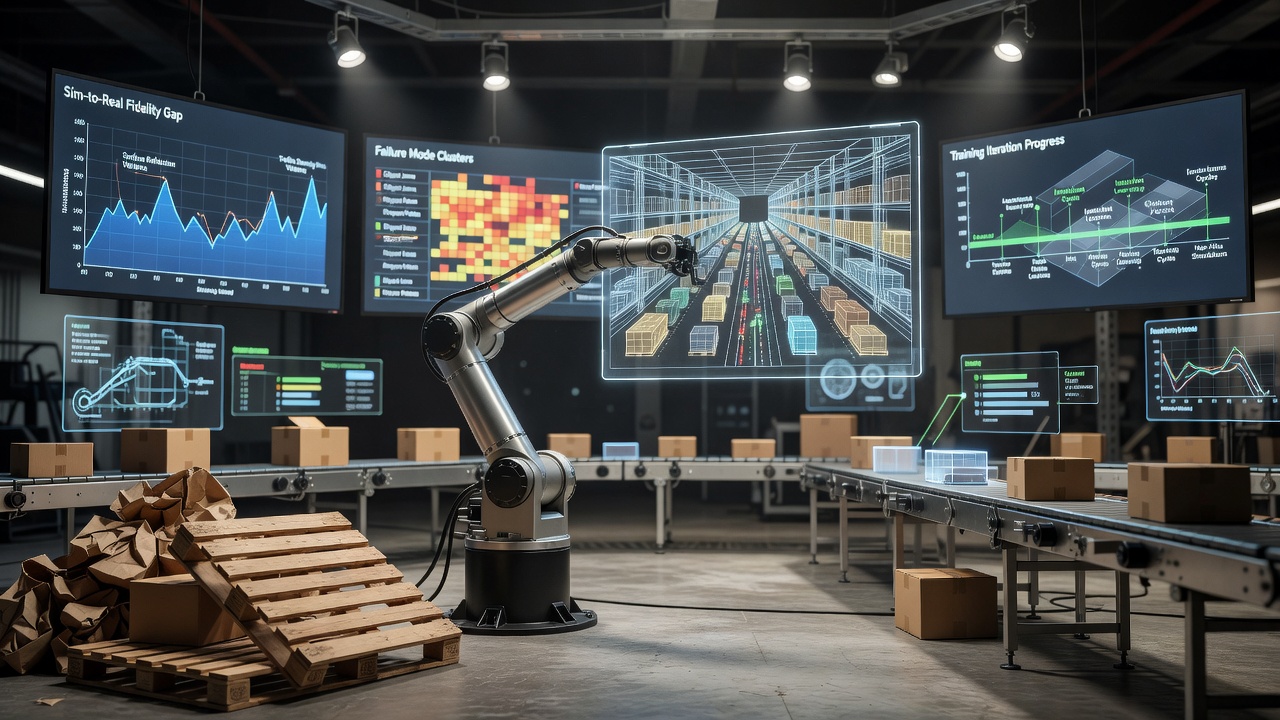
The gap between simulation and reality has long been a technical challenge, but in production robotics, it's a deployment problem. Modern robots must operate in spaces that change constantly—warehouse traffic shifts by the hour, packaging varies, and lighting conditions alter surface reflections. These small differences can turn a flawless simulation into a failed deployment.
"Real-world experience is expensive, slow, and sometimes unsafe to collect," said Mariusz Janiak, Ph.D., principal robotics architect at SoftServe Inc. "A virtual gym gives teams a controlled way to generate failure conditions before they appear in the field."
Learning-based approaches like imitation learning help, but they still require good demonstrations and sufficient variation. Physical trials risk stopping production, wearing out equipment, and creating safety hazards. Moreover, the most valuable training data—jams, dropped objects, near misses—rarely occurs often enough during normal testing to be useful.
Selective fidelity for specific failure modes
A virtual gym is not just a 3D model of a robot; it must represent the parts of the operating environment that cause the robot to fail. Fidelity should be selective. A mobile robot's route planner doesn't need the same physics as a deformable-object manipulation task or an inspection robot searching for fluid leaks.
The strongest virtual gyms combine multiple modeling methods: first-principles physics for motion and collisions, data-driven residual models to correct hard-to-capture effects, co-simulation for interacting systems, and surrogate models like neural ordinary differential equations to approximate complex behavior faster than full-scale simulation. In a factory, the model may include CAD geometry, camera placement, safety zones, and automation logic; in a warehouse, aisle geometry, SKU variability, and fleet behavior.
Synthetic data turns missing cases into test cases
For perception-driven robotics, the virtual gym doubles as a data engine. Industrial vision models need to recognize parts, pallets, defects, and people across many conditions—but real-world data often lacks sufficient variation. New products may exist only as CAD files, and rare defects may be unavailable.
A case study with Toyota Material Handling Europe illustrates the power of targeted synthetic data. A model trained with NVIDIA Cosmos achieved 89.6% precision and 84.7% recall on real-world datasets, while a simulator-only model reached only 49.4% recall. After post-training adapted the visuals to match the client's environment—including labels, colors, flooring, and shadows—performance rose to 99.5% precision and 92.8% recall.
Janiak emphasizes that synthetic data does not replace real-world data; it makes real-world data more valuable by using it for calibration, validation, and error correction. The recommended workflow is synthetic-first, real-calibrated, and continuously updated.
A five-stage deployment workflow
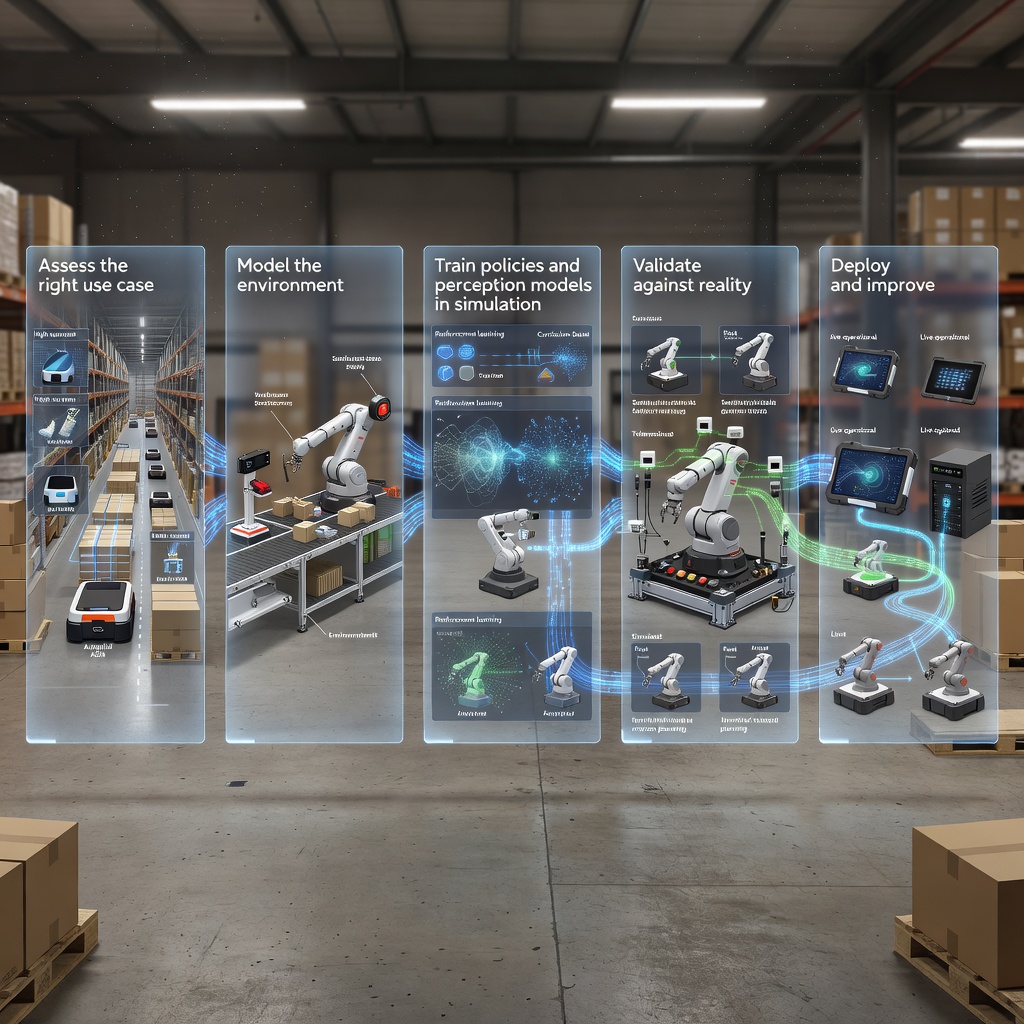
A production-ready virtual gym should be part of a larger lifecycle. Janiak outlines five stages:
- Assess the right use case – High-variance, high-value, or high-risk tasks like complex picking, weld-seam tracking, or autonomous material movement are the strongest candidates.
- Model the environment – The digital twin must include the robot, workcell, sensors, materials, and relevant physical effects, with fidelity driven by the task.
- Train policies and perception models in simulation – This includes reinforcement learning, curriculum-based training, synthetic data generation, and stress testing with safety constraints built in from the start.
- Validate against reality – Hardware-in-the-loop testing, real telemetry, and targeted physical trials compare simulated predictions with actual behavior to identify the gap.
- Deploy and improve – Containerized policies run on edge devices, while operational data feeds back into the simulation for continuous improvement of the robot fleet.
Virtual commissioning in industrial contexts can reduce commissioning time by 30% to 50%, giving teams more scenarios to evaluate before committing hardware or production time.
As robotics shifts from individual machines to coordinated physical AI systems, the virtual gym becomes a tool to move complexity upstream. "Real-world testing will remain necessary," Janiak concludes, "but robots should not encounter their most important failures for the first time in production."
Mariusz Janiak, Ph.D., is an academic lecturer and robotics principal architect at SoftServe Inc., specializing in advanced control, motion planning, and distributed real-time systems.
The source for this article is https://www.therobotreport.com/why-robotics-teams-need-virtual-gyms-before-deployment/.